- Really cool, all black design
- It is plain and mean at the same time
- EMG pickups, built for metal
- Leans toward heavier styles of music
- Discontinued, so finding the exact Iron Label model is very difficult
Hello there, and welcome back to yet another cool guitar review for you! This time, we will be examining one of the most beautifully designed electric guitars, which can serve as a great alternative to classic Ibanez RG designs: the Ibanez Iron Label RGIR20E. In this article, I would like to share my experience with the guitar and also provide you with a demo video.
Table of Contents
About Ibanez
For those who have never heard of the Ibanez brand, here’s a quick introduction. Ibanez is a Japanese guitar brand owned by the Hoshino Gakki company in Nagoya, Japan. Formerly known as Hoshino Shoten, the company started as a bookstore that also sold sheet music in Japan back in 1908. They quickly started selling musical instruments under the Hoshino Gakki company and also importing guitars made by a Spanish luthier, Salvador Ibanez. In 1957, they decided to use Ibanez as the brand name, thus becoming one of the biggest musical instrument companies in the world. Just like many other huge guitar brands in the early stages, Ibanez also didn’t have a factory of their own in the beginning and acted as a guitar trading company. Fender was also in the same situation until the company was sold to CBS, as well, and Gibson had a similar relationship with its parent company, Chicago Musical Instruments.
Interestingly, this was true for Ibanez until a much more recent era. Around the mid-60s, the Fujigen factory, which was manufacturing guitars for Ibanez, had grown rapidly, and in 1965, the company built a new factory in Matsumoto. During the 60s, it was one of the first guitar and musical instrument companies that made a massive impact in the USA and Europe with its clone guitars (which is called the lawsuit era). They eventually created guitar designs that are considered classics today. 
Short History of Ibanez RG Guitars
As Gibson brought suit against Ibanez due to their clone guitars, Hoshino Gakki did not want to fight against it, as the company could be in the same situation not just with Gibson but also with other guitar manufacturers. This era was the triggering moment for Ibanez to take a look at the company’s long-term ambition in the guitar business. Through the 70s, Ibanez worked with various artists who featured Ibanez’s original designs, such as Paul Stanley, Steve Miller, George Benson and Bob Weir. However, moving forward with the 80s shredders era, they still had issues with their brand identity. What Ibanez wanted was someone like Eddie Van Halen, and what he did for the Kramer brand. Ibanez had already worked with legendary guitar players such as Lee Ritenour, Joe Pass, Steve Lukather and Alan Holdsworth, but the company was missing a rockstar image that could boost the brand’s identity.
After having long discussions and meetings, they decided to go to Steve Vai! Vai was already getting a lot of attention when he joined Frank Zappa at the age of 20 years old. Later, he replaced Yngwie Malmsteen in Alcatrazz and also released his debut album. Around 1985, he joined David Lee Roth’s band, taking giant steps into the rock music scene. Vai was already cooperating with other guitar brands such as Kramer and Yamaha, but his customisation needs were usually neglected, and he ended up with pretty much the same standard models that these companies manufactured with some tweaks for him. 
Ibanez eventually managed to contact Steve Vai and got his attention, and their cooperation, which changed the guitar designs profoundly, had just started! Legendary luthier, Mace Bailey at Ibanez, made prototypes for Steve Vai based on his input and came up with the JEM design, which would later give birth to the legendary RG series. When JEM design was first introduced to the masses at the NAMM show, it completely blew away the audience and got praised as the ultimate alternative guitar design to actually buying a custom-made guitar. Due to excellent sales figures, Ibanez also came up with RG550, a JEM design but without the edgy aesthetics of the original Vai design. Since then, RG design guitars have been released with additional variations throughout the years. As you can understand, one can easily trace RG’s roots back to these modern and edgy guitar designs that rocked the world. The Ibanez RG series is now considered one of the most distinct and unique guitar designs of all time and is praised as a classic series. Just like your Stratocasters, Les Pauls or Teles. 
A Short History: Ibanez JEM & RG by 5 Watt World
If you want to know more about all these cool details and the history of Ibanez RG guitars, I suggest you check out the “A Short History: Ibanez JEM & RG” video by 5 Watt World. There are so many cool things you can learn from this channel!

Ibanez Iron Label RGIR20E
As you can understand from the short history of Ibanez RG design, they were once considered edgy, bold and progressive. But today, we take them as a classic design. Ibanez RG has been able to place the brand among the biggest guitar brands, such as Fender and Gibson, and it doesn’t seem to go away from the guitar scene! Ibanez Iron Label RGIR20E is a solid-body electric guitar that was released in 2013 and made in Indonesia. This alternative RG series was called the Iron Label, which focuses on more metal-focused guitars. Ibanez Iron Label RGIR20E bears most of the classic RG design components, such as a basswood body, bolt-on maple neck with Bubinga reinforcements, and a 24-fret rosewood fingerboard. The neck design was Ibanez’s Nitro Wizard neck and features no inlay or binding.
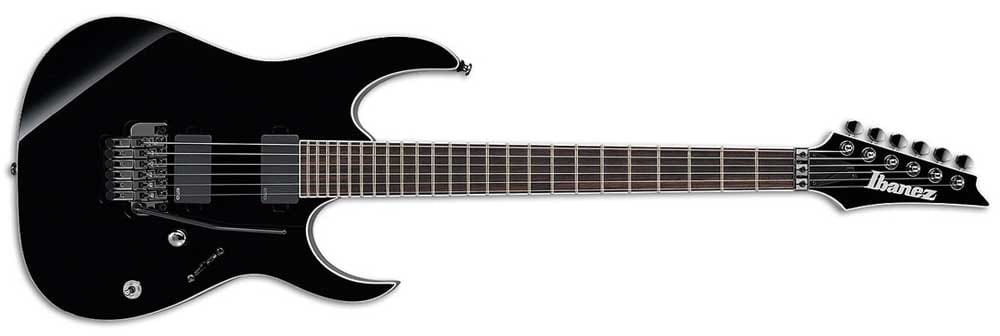
It also comes loaded with the Edge Zero II, double locking tremolo bridge and EMG 60 and EMG 80 active pickups. As a unique feature, it also has a kill switch! Iron Label RGIR20E was discontinued in 2016 and replaced by upcoming Iron Label variations in the following years. Before I provide you with my quick Ibanez Iron Label RGIR20E review, let’s have a quick look at the tech specs below. 
Tech Specs
| Ibanez Iron Label RGIR20E | Tech Specs |
|---|---|
| Body Type | Double cutaway RG - Solid body |
| Body | Basswood with high contrast binding |
| Neck joint | Bolt-on (4 bolts), AANJ |
| Bridge | Edge Zero II tremolo |
| Knob style | Metal knobs |
| Hardware color | Cosmo Black |
| Neck type | Nitro Wizard |
| Neck material | 3pc Maple/Bubinga neck |
| Scale length | 648mm (25.5 inches) |
| Fingerboard material | Rosewood with binding |
| Fingerboard inlays | N/A |
| Frets | 24 / Jumbo frets |
| Nut | Locking nut (43mm) |
| Machine heads | Ibanez |
| Pickup configuration | H/H |
| Bridge pickup | EMG® 81 (H) bridge pickup (Active/Ceramic) |
| Neck pickup | EMG® 60 (H) neck pickup (Active/Ceramic) |
| Controls | 1 volume, 3-way pickup selector, kill switch |
| Made in | Indonesia |

Sound Dem0 (no talking)
Like the other full reviews, this video was recorded again with a Marshall JVM205C valve amp and a Shure SM57 microphone directly into the TC Electronic Impact Twin. As you can see, I titled this article “Plain and Mean“, and I meant that! Ibanez Iron Label RGIR20E was one of the electric guitars that I enjoyed testing and playing while working in the MI industry. Unfortunately, this guitar came in possibly twice. I like how it looks so plain without any additional visuals, such as dot inlays and how it is designed in a great black finish all around the guitar. Back in those days, EMG pickups were not the most common on Ibanez RG variations, so it was a unique experience to play one with active pickups.

Review
I’m not the biggest fan of active pickups. Mind you, after having owned, used, played and tested hundreds of electric guitars, I have started to think that the pickups do not act like the magical EQs that we place on the guitars; rather, I think that the pickups are more like microphones with different fixed output levels. Apart from how a guitar feels and plays based on its design, the pickups are just the components that determine how much gain you can get from an amp, because they have a huge impact on the level of the output. As you can hear from the video, infamous EMG pickups generate a lot of gain! Note that we never adjusted the amp settings in any of our unbiased guitar review videos. Most people criticised that as well as criticised that we were using a Marshall JVM205C, which was not the most affordable guitar amp for beginners. However, we always wanted to provide our customers with the best sounds from the instruments we test and play every day. So basically, by listening to those videos, one can easily understand how different these guitars sound under the same conditions.
Ibanez Iron Label RGIR20E has a huge output due to EMG active pickups and easily drives any channel without a boost pedal. When I was moving to high-gain stages on the amp, it was apparent that the amp was driven so hard that you could even start hearing tremolo springs through the amp! Note that this is not a design flow! You may have this experience with any guitar due to the tremolo springs vibrating a bit too much, and you end up with these annoying sounds coming through your amp (watch the video towards the end). This does not mean that you shouldn’t do anything about it. The solution is pretty simple. Just get a piece of foam and place it over the springs. If you want this solution to look neater and cleaner, then you can cut foam pieces of the same length with a spring and place them inside the spring using a piece of guitar string.
As we all know, mankind is a visual animal, and we as guitar players are the biggest fans of the guitars that we love the looks of! 🙂 Ibanez Iron Label RGIR20E features an impressive design in my opinion, and it made me play more and more during the demo session. Note that I would usually spend around 1 hour on each guitar, but in some cases, I would do 2 hours of sessions to record it in the best way possible. Iron Label made me play more and more! The neck was a typical Ibanez neck and extremely comfortable, too! Edge Zero II tremolo was also a pretty successful design that you may see in modern Ibanez RG models, and feels way more slick than the initial version. During the session, I did not have any tuning issues; however, bear in mind that if you excessively use your floating tremolo, your guitar may go out of tune eventually. And that’s very normal. But based on my experience with hundreds of guitars, a nicely set-up Floyd Rose-type bridge has always been the most stable when it comes to tuning stability. I used to think the opposite was true! But I learned that it wasn’t the case. So, do not fear the FR bridges! 🙂
Overall, I dig this alternative RG design with a metal focus and recommend anyone to try it if you can! However, Ibanez Iron Label RGIR20E is no longer in production, and there has been a set of new instruments under this series. But as with all guitar manufacturers, Ibanez also has to lower the costs and has started using alternative woods on this new series, such as okoume or nyatoh on the body. On some models, you may find rosewood fingerboards (but very much like Pau Ferro-looking ones) and ebony as well. As I always mention, I believe 2010 to 2015 was the golden era for the best value/money guitars with top materials! I played so many great guitars from this era. The price tags always seemed reasonable, the build quality was a lot better, and the options were a lot better suited for my taste back in those days. After the CITES regulation, it was almost impossible to find high-quality rosewood boards on guitars that are made in Asia. Fortunately, in 2024/2025 and present, it’s no longer a problem for guitar manufacturers to use rosewood. 
Pricing & Availability
Unfortunately, this guitar was long discontinued. As far as I remember, this was in production between 2013 and 2016 or so. Although Ibanez discontinued this particular model, the Iron Label series is still offered with different variations of the same theme. So, you can check out what’s available in the series as brand new products (including bass guitars!) here on Thomann.
Check out Iron Label series on Thomann here
If you want to chase this particular Iron Label model, RGIR20E, chances are your only option is to go for the used ones. Currently, there’s one listed on Reverb.
Check out the Ibanez Iron Label RGIR20E on Reverb here
As Ibanez releases many variations of the Iron Label theme regularly, you may also want to check out Amazon. Surprisingly, Amazon stores list many Iron Label guitars.
Check out Iron Label series on Amazon here
I hope you have enjoyed this brief guitar article. Thanks for visiting my blog and supporting me so far! I will hopefully see you in the next review here!