- Excellent, modern British combo amp
- Features a nice clean, crunch and OD channels from the legendary JVM amps
- Versatile mix of Celestion speakers in the samp amp
- Sweet sounding reverb
- Smartly designed footswitch
- It's heavy and loud
- Only go for these amps if you have a place to use them properly
Hello there, back again with another article for you! This time, we will be looking at an excellent, versatile and high-value/money guitar amp by Marshall Amps! In this Marshall JVM205C review, you will find some insights from a very long-time user (that is me!). Somehow, I noticed that I haven’t featured this amp yet on my blog, which is a shame! I also recalled that during my service in the MI industry, while shooting guitar review videos, I used this amp extensively.
Table of Contents
To be exact, in almost 3 years, I used this amp in over 200 guitar videos. Each recording session would take me about 2 hours, depending on how much I sucked on the guitar on that day! A big portion of these videos is never released due to priority shifts in the company. This real-world experience actually helped me to understand its capabilities, and I always enjoyed its company! That’s why I wanted to give honours to this beautiful guitar amp here, finally! As you may know, my early bonding with this amp later led me to go for JVM series amps a decade later.
About Marshall Amplification
Here’s a quick introduction for those who have never heard of Marshall Amplification (I bet a few people there would be!). Marshall Amplification is a British company founded by Jim Marshall and his son Terry in 1960 as a family-run business under the name Jim Marshall and Son. Most of the stores in the business serviced jazz musicians since it was the hype, but Marshall’s store found a different niche by attracting rock musicians and building its reputation.
They quickly became the leading amplifier store in the region. Back in the day, it was not easy to find amplifiers for rock guitarists, so they decided to devise their own design. Oddly enough, Jim Marshall was a drummer, and Terry (who is a service engineer) was a sax player. None of them really could play the guitar. They started experimenting with different components and tried to come up with their design using their non-guitarist ears.
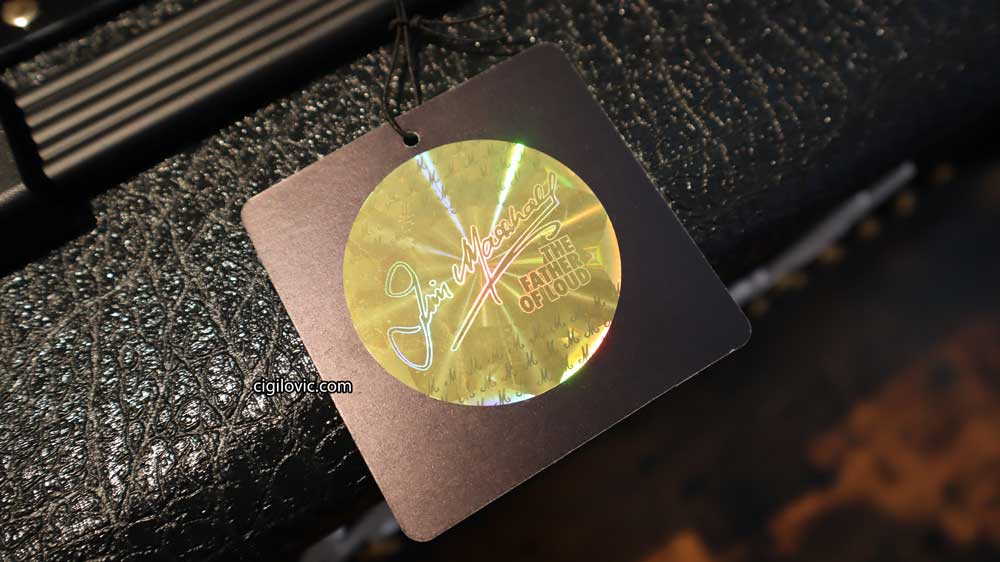
Their first amplifier was the JTM45, which stood for Jim & Terry Marshall back in 1962. That was the moment they started to redefine the sound of the blues and rock that would span across decades and still be rocking strong! JTM45 is actually the start of everything and has managed to stand up for decades, and is still a base for the Marshall DNA! JTM45 was inspired by Fender’s Bassman circuit with British parts like KT66 tubes, which gave it a distinct, warmer tone. In 1965, Marshall released their legendary Super Lead, 100w Plexi model, which is Model 1959! The Plexi was aimed at the volume and power needed for stadium performances. The Plexi name was the nickname of this amp, as it features a “Plexiglass” front panel!
Please consider supporting this blog by buying your gear from Thomann using my links at no extra cost to you, many thanks!

In 1970, Marshall released yet another beast of an amp called the Marshall Major, which featured a 200W power section for extreme loudness! The company kept innovating and releasing new models in the upcoming years. In 1975, the company released the JMP Master Volume Series, which is also known as the Model 2203 and Model 2204. The master volume controls, which allowed players to get distortion without cranking the loudness control, were introduced with this series. This became a favourite among early hard rock/metal guitar players.
During the 80s, Marshall released an amp that is still considered the staple of hard rock and metal genres through the decades. In 1981, the company released the JCM800 (Model 2203), which was named after Jim Marshall’s initials and the licence plate on his car. It featured a single-channel design with high-gain and aggressive character used by heavy metal/hard rock bands like Slayer, Iron Maiden and Guns N’ Roses. In the late 80s, Marshall started releasing amps with modern features. One of the first releases was the Silver Jubilee (Model 2555) in 1987 to celebrate Marshall’s 25th anniversary and Jim Marshall’s 50th year in the music business. Unlike the traditional Marshalls, SJ featured a silver finish and switchable output power settings. In the early 90s, Marshall kept on modernising their amps and released the first DSL (Dual Super Lead) in 1997 with a built-in effects loop and more user-friendly features. Towards the 2000s, the company kept on innovating and started offering TSL (Triple Super Lead) in 2000, which featured two channels for modern guitar players. 
In 2007, the company came back to the amp market with its flagship (still is) Marshall JVM410H, which featured 4 channels with 3 modes on each channel, built-in reverb and FX loops. The JVM-era designs naturally contained Santiago Alvarez‘s legendary amp design, including the signature amplifiers. In 2012, Marshall released the JVM410HJS Joe Satriani signature model as well as the YJM (Yngwie Malmsteen) and Kerry King models.
Check out my JVM410HJS Joe Satriani signature review here
Marshall also started paying attention to the digital modelling amp market and started offering the Code Series, which featured Bluetooth connectivity and integration with Marshall’s smartphone app. As the company was approaching the 2020s, it was often criticised for not innovating more and coming up with new designs. On top of that, due to the amp modelling being on the rise and the need for full-blast 100-watt tube heads diminishing, Marshall decided to come up with the Studio Series (Mini Versions of Classic Marshalls).
Marshall released this extremely popular series with the amps featuring Marshall SV20H (Studio Vintage, Plexi), SC20 (Studio Classic, JCM800), and 2525H (Mini Silver Jubilee), as well as made-in-Vietnam DSL, which were very affordable. Around 2021, they came back with the Origin Series, which was basically the affordable version of the vintage British tone from the early JTMs. While the market wasn’t expecting new releases from Marshall, Marshall quietly released yet another Studio Series amp, this time a JTM ST20H, surprising everyone! 
As the amp market has been shrinking, Marshall has decided not to invest in big musical exhibitions such as NAMM. However, in 2025, they announced their comeback and released killer amps, again by listening to user feedback. These amps include Marshall 2203 Modified JCM 800, Marshall 1959 Modified and another Studio Series featuring Marshall SN20H Studio 900 (Mini JCM900).
Almost all legendary guitar heroes played Marshalls, such as Jimi Hendrix, Jimmy Page, Slash, Eric Clapton, Graham Coxon, Zakk Wylde, Angus Young, Joe Perry, Simon Neil, Joe Trohman, Noel Gallagher, Lzzy Hale, Sid Glover, Joe Bonamassa, Jeff Beck and many more. The list would be endless!!!
Marshall JVM205C
On the front panel of Marshall JVM205C, you will see dual identical controls for clean/crunch and overdrive channels. Next, you have your “Reverb” section, where you can adjust the effect level individually for each channel. Last but not least, you have also your Master section, which allows you to adjust “Presence“, “Resonance” and individual “Master Volume” settings for each channel.

Pressing channel buttons on the left-hand side gives you dual functions. On the same channel, when you press the channel button, it will cycle the gain modes from Green (lowest gain) to Orange to Red (highest gain) and on top of that, each mode will recall the previous FX, Reverb and Master settings. If you are, for instance, on the Overdrive channel and press the channel buttons on the Clean/Crunch channel, the last setting on this channel will be recalled. 
Tech Specs
| Marshall JVM205C | Tech Specs |
|---|---|
| Channels | 2 Channels with 3 different modes |
| Output wattage | 50W |
| Outputs | Speaker outputs: 5 x 1/4" jack sockets (16Ω load / 8Ω load / 4Ω load), Emulated Line Out (XLR), MIDI Thru |
| Inputs | 1 x 1/4" jack instrument input, MIDI In, Footswitch |
| Controls | Channel and mode select (button), gain, treble, middle, bass, reverb , presence, resonance, master volume select, master volume (switchable for each channel) |
| Effects | Digital reverb |
| Effects loop | 2, 1 x series parallel, 1 x series |
| Speaker configuration | 2x12" |
| Speaker model | 1 x Celestion Heritage G12H (8Ω, 80w), 1 x Celestion Vintage (8Ω, 70w) |
| Unit impedance | 16Ω |
| Preamp valves | 4 x ECC83, 1 x ECC83 (phase splitter) |
| Power amp valves | 2 x EL34 |
| Footswitch | PEDL-91006 included |
| Cable | Detachable power cable included |
| Weight | 29.5 kg / 65 lbs |
| Width | 690 mm / 27.2" |
| Height | 510 mm / 20.1" |
| Depth | 265 mm / 10.4" |
As you can see, this amp gives you a total of 50W output power. If you are already familiar with valve amps, you will know that this is an insanely huge power level for an amp! You can actually gig with this in big avenues without microphones, as it has the power to project. Believe me, I used to play this amp in a small room with acoustic treatment and could hardly increase the volume of each channel, as it would get really loud. It also features 4 x ECC83, 1 x ECC83 (phase splitter) preamp valves and 2 x EL34.
ECC83 are the same type of valves with 12AX7
On the back, you have MIDI IN/OUT, Line Out for silent recording, power amp in/return or preamp out/send inputs, and serial/parallel fx loop with level control. Also, you have 4 different speaker outputs with different Ohm levels. There are countless options, variations and flexibility possibilities in using Marshall JVM205C, and to be honest, I don’t really want to make this article too long. So if you want to know more in-depth functionalities of this amp, I highly suggest you check out the official manual.
This amp also features a dual speaker system that consists of a Celestion Heritage G12H (8Ω, 80w) and a Celestion Vintage (8Ω, 70w). Top-notch, industry-standard brands and models for guitar speakers! All made in the UK!

Clean/Crunch Channel
This channel was always featured in our unbiased guitar videos, especially in the opening section. I would use it to show some crunchy tones of the guitars usually featuring in-between pickup positions. I believe using in-between pickup positions with crunchy tones or pushed valve amp settings often shows the potential of the pickups. Really tough to explain in words, but when you really dig into the strings and really push the amp with dynamics. 🙂
Only fools keep their cash in a bank account! Let your money work for you with the most trustworthy broker ever!

On this channel, you have a Green mode, which is the cleanest mode. In this mode, volume control is taken out of the circuit, and it’s the only JVM mode where this happens. Next, you have your Orange mode, which resembles Marshall JTM45/1959 Plexi models with an added gain. It is perfect for just in between gain settings while retaining fuller sound without getting too thin! Lastly, you have the Red mode, which features more gain than the Orange mode. This mode will give your JCM800 2203 amp characteristics, which are standard characteristics in the hard rock genre.
I played Marshall JVM205C in almost every video here, so please check out!
Overdrive Channel
I was also a big fan of the Overdrive channel on this amp and used it mostly on solos and rhythm parts in the unbiased review videos. You still have 3 modes here, just like in the clean channel. On Green mode, it is similar to a hot-rodded JCM800 (clean/crunch channel, red model). So, actually, with the above Red mode and the Green mode on this channel, you are able to dial in two different but similar crunchy guitar tones. On the Orange mode, there’s extra gain added to this base tone, and it’s ideal for lead playing with a nice amount of compression. Lastly, you have your Red mode, which will give you the highest amount of gain among any options on this amp. In our unbiased guitar review videos, I always use the clean channel on the Green mode as a starter to show our visitors clean tones that you can get from any guitar with all settings at 12 o’clock.
I would usually switch to the Orange mode on the same channel to play some single-line riffs to show how pickups respond with some extra push. And finally, I would switch to the Overdrive channel on Orange mode and play mostly leads, guitar solos and riffs that we picked up for the video. Let’s have a look at the tech specs briefly below.
Verdict
If you are into electric guitars, I’m sure you are aware of the importance of Marshall amps. Along with Fender amp sounds, Marshall is also considered a pillar in the guitar amp world. When British sounds are wanted, it’s the Marshall amps that will deliver! When I first started playing the guitar, I wasn’t really aware of these foundations, but later on, I discovered that Marshall sound is my all-time favourite guitar amp brand. Regardless of what guitar I have at the moment, be it a Strat, LP type, 7-string…etc, I always look for Marshall sounds as my base guitar tones. Having played with Marshall JVM205C as well as many other models in the studios, I can easily say that if I were to buy a guitar amp today, it would be a Marshall model.
Unfortunately, I can not invest in guitar amps as I have to live in a small space. Marshall JVM205C is an extremely flexible amp that offers almost classic and modern Marshall vibes in a single box! If you have the chance to play loud, I would definitely recommend you check this model. You have more than enough channels and modes to cover an entire gig consisting of many different genres. As a last note, Marshall JVM205C is a single member of the whole JVM family. I highly suggest you check out other JVM models in head format or differently configured combo models.

Pricing & Availability
As always, since I bought my 410H from Thomann, I can only recommend you do the same for Marshall JVM205C, as they usually offer the best prices in the EU, and they always have everything in stock!
Check out JVM205C on Thomann here
However, feel free to check out Reverb.com as well, as you may find great offers in the used market. There are sometimes crazy deals on these amps in the used market as well. I didn’t want to go for this route as it’s a tube amp. But it’s up to you!
Check out JVM205C on Reverb here
I hope you have enjoyed this content, as I wanted to provide you with a real-life experience with this wonderful guitar amp. Thanks for visiting my blog and supporting me so far! I will hopefully see you in the next review here!