- 10 band EQ with gain and volume
- Very well built, durable pedal
- You can go really surgical and completely change your guitar tone
- Comes with its 18V power supply
- A little aggressively priced
- Extremely bright, blinding LEDs (that you should replace or remove)
- With every EQ pedal, it may be overwhelming to control all those frequencies
Hello there, and welcome back to yet another gear review for you! This time, we will be looking at possibly one of the most overlooked guitar pedals, the MXR 10 Band EQ. In this article, I will do my best to provide all the details that you may need to know about this EQ pedal and also an in-depth review along with a test video.
Table of Contents
About MXR
Since its founding in 1972, MXR has been a trailblazer in the world of guitar effects, helping define the tone of modern music through decades of innovation, grit, and unmistakable sound. Born in Rochester, New York, the brand was founded by engineers Keith Barr and Terry Sherwood, who envisioned a new generation of compact, durable, and great-sounding pedals for working musicians. The result? A lineup of rugged stompboxes that became staples of the stage and studio, earning MXR a place among the most iconic names in guitar history. From analogue classics to modern innovations, MXR pedals are trusted by bedroom players and arena headliners alike. Whether you’re chasing vintage warmth, crystal-clear modulation, or aggressive distortion, MXR delivers the tone you can count on.
A Legacy of Iconic Pedals – Analogue Innovations
Over the decades, MXR has produced some of the most sought-after and enduring effects in the industry. Here’s a look at a few of the standout models that have shaped its legacy:
Phase 90 (1974)
The original MXR release is still one of the most popular phasers of all time. With its signature swoosh and single-knob simplicity, the Phase 90 helped define the sound of Eddie Van Halen and countless others.
Dyna Comp (1976)
A legendary compressor that delivers smooth sustain and signature “squash.” Essential for funk, country, and lead guitar tones.
Micro Amp (Late 1970s)
A clean boost classic, offering up to +26dB of gain with just one knob. The Micro Amp is perfect for pushing amps, balancing guitar volumes, or giving solos a transparent lift. It’s still a go-to tool for tone shaping today.
Distortion + (1975)
One of the first distortion pedals ever made, delivering gritty, amp-like drive. Used famously by Randy Rhoads, it remains a favourite for vintage rock tones. 
This fuzzy, glitchy pedal combines heavy fuzz with a sub-octave effect for chaotic, synth-like textures. Famously used by Jimmy Page on Led Zeppelin’s “Fool in the Rain.”
Flanger & Chorus (Late 1970s–80s)
Warm, lush modulation pedals that offer rich depth and movement. The MXR Flanger and Analogue Chorus became key components of ’70s and ’80s guitar tones.
Carbon Copy Analogue Delay (2008)
A modern classic featuring warm, bucket-brigade repeats and built-in modulation. Its lush, vintage-style echoes made it an instant favourite across genres.
A hot-rodded take on classic distortion, this pedal delivers rich, saturated drive with modern tweakability.
Signature and Artist Series
MXR has collaborated with iconic artists to develop custom pedals tailored to their unique tones, such as the EVH Series, including the EVH Phase 90, Flanger, and 5150 Overdrive, inspired by Eddie Van Halen’s gear, Zakk Wylde Series, built for high-gain riffing and soaring solos, Timmy Overdrive (Mini, a compact take on the legendary transparent overdrive, done in collaboration with Paul Cochrane, Slash Octave Fuzz, Kerry King EQ, and more.
Powered by Dunlop
In the 1990s, MXR found new life under Dunlop Manufacturing, Inc., which revitalised the brand while preserving its analogue soul. Under Dunlop’s stewardship, MXR continues to expand its product line, blending vintage character with modern features and maintaining the brand’s reputation for durability, reliability, and tone. Today, MXR remains a trusted name for musicians around the globe, from weekend warriors to world-famous headliners. No matter the genre or playing style, MXR has a pedal that fits your sound.
What is an EQ Pedal?
As you may already know, EQ stands for equalisation and is possibly the most overlooked guitar pedal/effect. The audible frequencies we can hear can be found in a pretty wide spectrum. Human ears can identify frequencies from 20Hz to 20kHz.EQ pedal simply is a tool to manipulate the frequencies by cutting (decreasing) or boosting (increasing) found in your guitar or any other instruments and sounds. EQ as an effect can be found in many formats, such as guitar stomp boxes, racks, built-in circuits or digital plugins. So, actually, EQ is not a guitar effect but a very powerful sound-sculpting tool. 
Graphic EQ vs Parametric EQ
Depending on the design of any particular EQ, you may have a graphic or a parametric EQ. Graphic EQ features a set of sliders that are predefined to control certain frequencies, and the number of sliders may vary depending on the design. As the subject of this article, the MXR 10 Band EQ features 10 bands of frequencies that you can control. There are also EQ units in rack formats that feature up to 31 bands. There are also parametric EQ pedals and units. Just imagine the basic EQ controls on your amps; you can apply parametric curves to certain frequency groups by turning the knobs instead of using the sliders. Of course, there are also design principles that make these two EQ types different. But hey, let’s keep it simple here. 🙂 It is not so wise to say one is better than the other, as what kind of EQ would be applied to the audio depends on the design of each particular unit.
Frequency Ranges
Generally speaking, we can classify the frequency ranges or zones as follows.
From 30Hz to 200Hz is usually considered bass or low-end frequency range, while 200Hz to 800Hz is a mid-frequency range, and lastly 800Hz to 12.8kHz is treble, high or high-end frequency range.
Why Do You Need an EQ Pedal?
It’s simply because you want or need more control over your audio gear, amp or preamp. As I have been featuring my gear here, I have been using my ENGL E570 all-tube preamp for a while. Recently, I also got an Ibanez Tube Screamer Mini pedal to boost the front end of the E570 and get tighter and more aggressive tones. However, I don’t think the built-in EQ can do surgical operations on my guitar tone. Especially when you have many guitar types such as Strat style, Les Paul style or extended range guitars, it gets pretty limited, and you can not control the full spectrum with extreme sensitivity.
EQ in FX Loop or Front?
Placing the EQ pedal is basically up to what results you are aiming for. However, it’s good to know what kind of sonic and functional differences these options will provide.
EQ In Front of an Amp or a Preamp
When an EQ pedal is placed in front of an amp or a preamp, it will yield results which are similar to a boost pedal, or just like turning your volume down on your guitar. This approach has a more significant impact on the response of your amp or preamp.
EQ in the Effects Loop of an Amp or a Preamp
When an EQ pedal is placed in the effects loop of an amp or a preamp, it acts like post-EQ and allows you to tweak and precisely adjust your overall tone.
Based on my research on the internet for quite some time, I have found out that most guitar players are die-hard fans of EQ pedals in the loop. So initially purchased an MXR 10 Band EQ pedal to use in the FX loop of my ENGL E570 preamp.
MXR 10 Band EQ
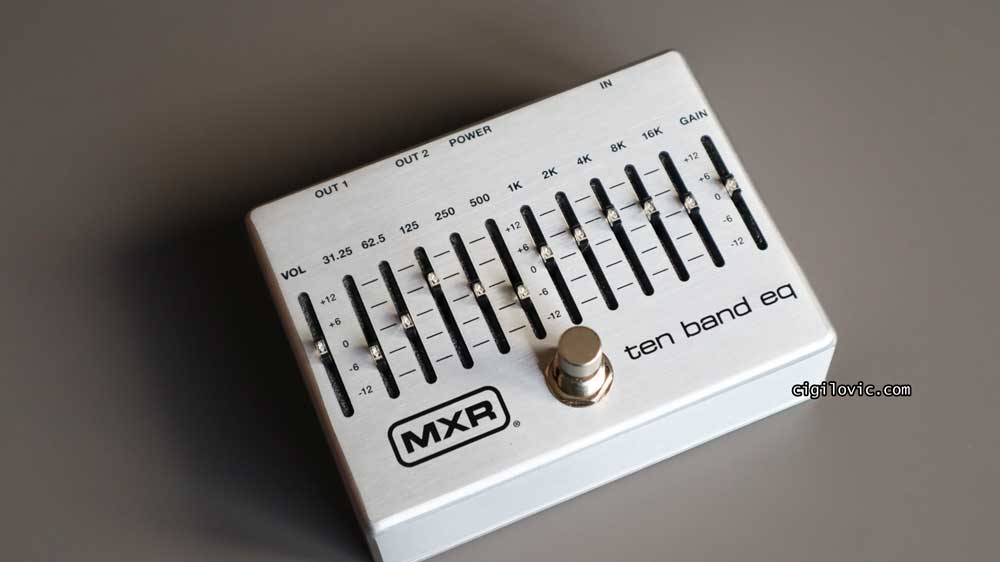
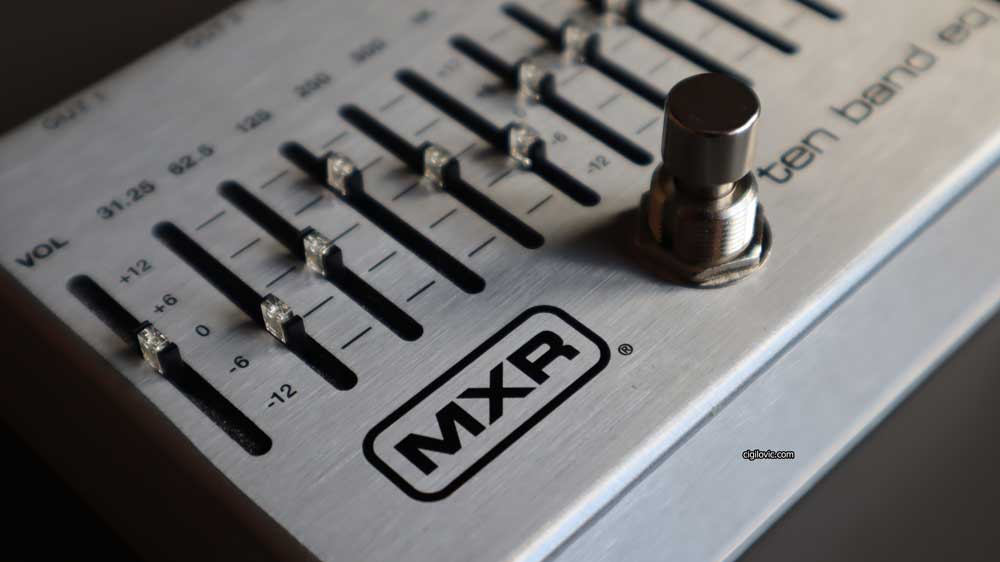
When it comes to EQ pedals, you have many, but quite a few good options out there. However, MXR is probably one of the most popular and sought-after brands when guitar players are hunting for an EQ pedal. MXR 10 Band EQ features a lightweight aluminium chassis, extremely bright (!) blue LEDs, true bypass switching and dual outputs. With 10 Bands, you can control all the frequencies of your guitars easily. As some of you may already know, there was a previous version of the MXR 10 Band EQ.
It was also a big success for the company. However, with this new silver version, they have upgraded the noise-reduction circuitry, true-bypass switching, and a second output. You also have a volume, gain control and 10 sliders to boost or cut certain frequencies. With the volume control, you can control the overall volume of the EQ effect, and with the gain control, you can adjust the amount of the gain boost. EQ sliders on the MXR 10 Band EQ provide you with ±18dB boost or cut! Before I provide you with my review and the MXR 10 Band EQ test video, I would like to share the tech specs below. 
Tech Specs
| MXR 10 Band EQ | Tech Specs |
|---|---|
| Input Impedance | 470 kΩ |
| Output Impedance | 5 kΩ |
| Max Input Level All Sliders at 0 dB | +14 dBV @ 1 kHz |
| Max Output Level All Sliders at 0 dB | +14 dBV @ 1 kHz |
| Frequency Response | ±1 dB, 20 Hz to 20 kHz |
| Noise Floor | -101.4dBv |
| Filtering ±12db @ | ±12dB shelf @ 16kHz |
| 31.25, 62.5, 125, 50, 500, 1k, 2k, 4k, 8kHz | |
| Switching | True Bypass Hardwire |
| Power Supply (Included) | 18 Volts DC |
| Current Draw | 48 mA |
| Made In | China |
Review
As you can see, it’s a pretty basic EQ pedal with some outstanding features. It features a 10 Band EQ, which is,s in most cases, overkill. You have so many angles to hit your guitar tone and completely manipulate it. One of the things I immediately noticed with the MXR Ten Band EQ is that it’s extremely sensitive! Even the slightest changes make a massive difference in your guitar tone, thanks to its design that gives you 18dB headroom. If you look at other EQ pedals in the market, you will notice that most of them operate with a 9V power supply. But the MXR Ten Band EQ operates with an 18V power supply, which is included in the box. When combined with a nice amp or preamp, you can change the characteristics of your amp significantly. Before I bought my MXR 10 Band EQ, I did a lot of research and noticed that people were big fans of EQ pedals in general, and they claimed that EQ pedals change the characteristics of their amp so effectively. At first, I thought they were exaggerating and justifying their purchases. But seriously, it’s one of the best purchasing decisions I have ever made. About the noise issues that some people mentioned, I haven’t had any noise issues whatsoever. Not sure what they are talking about, really. It’s pretty quiet, and it sounds excellent.
Price Tag
For those who are curious about where this pedal is made, it’s made in China! That was a bit surprising for me as I thought that at this price range, it could be a US-made pedal. As it’s just an EQ pedal, I think you could justify the European price tag, which is around €200. But it’s made in China. Because it comes with an 18V power supply, you could still justify the price tag if you force yourself a bit. However, I believe the correct pricing would be around €150 to €160. But I understand the strategy behind this pricing. There are a lot more complex, DSP-based EQ pedals on the market, and they cost a lot more than an MXR 10 Band EQ. So they kinda positioned them in between these products and some of the more generic and simpler EQ pedals. As this is an EQ pedal, it doesn’t make sense to talk about how a +4dB boost @ 125Hz sounds like, right? 🙂 So I am trying to include the other aspects of a product in my review, please understand. The experience I had with the product was pretty good, but with some of the things I noticed, I was a bit disappointed. 
The Box Content
It comes with a really cool and pretty big black box. You also need a smaller box for the power supply. On top of that, you have a nice MXR sticker and 2 pairs of 3M pads that you can stick to the bottom of your pedal for better stability. I also had a quick guide, which has 70-something pages of basic guidance. However, the MXR 10 Band EQ was not even mentioned in this guide! Pretty weird, as it gives the impression that they did not spend so much time on the MXR 10 Band EQ manual.
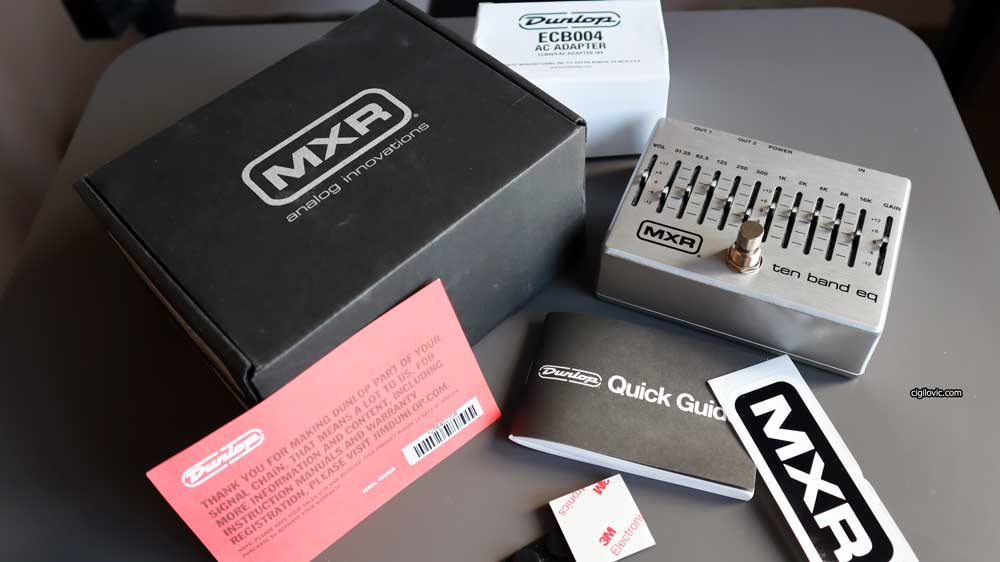
I mean, I wouldn’t expect pages of information about an EQ pedal, but at least provide some basic information within the box content, and maybe some guidance regarding possible presets and approaches.
If you want to check out the official MXR 10 Band EQ manual, please click here and visit the Jim Dunlop/MXR website.
Brightest Blue LEDs Ever!
This is something you may come across in customer reviews online. As you can see for yourself, even on the official Jim Dunlop website, this was mentioned as an upgrade! I’m completely lost with their logic and can not understand why on earth someone put the brightest blue LEDs on this pedal! Especially when combined with a silver/grey chassis colour and black letters and numbers, it’s impossible to read. Maybe I should change this sentence a bit, it’s impossible to look at it! This similar issue also exists on my ENGL Cabloader, and I must say it’s tiring to look at this combination. However, I have to admit that the MXR 10 Band EQ with these brightest blue LEDs have set the bar so high! 🙂
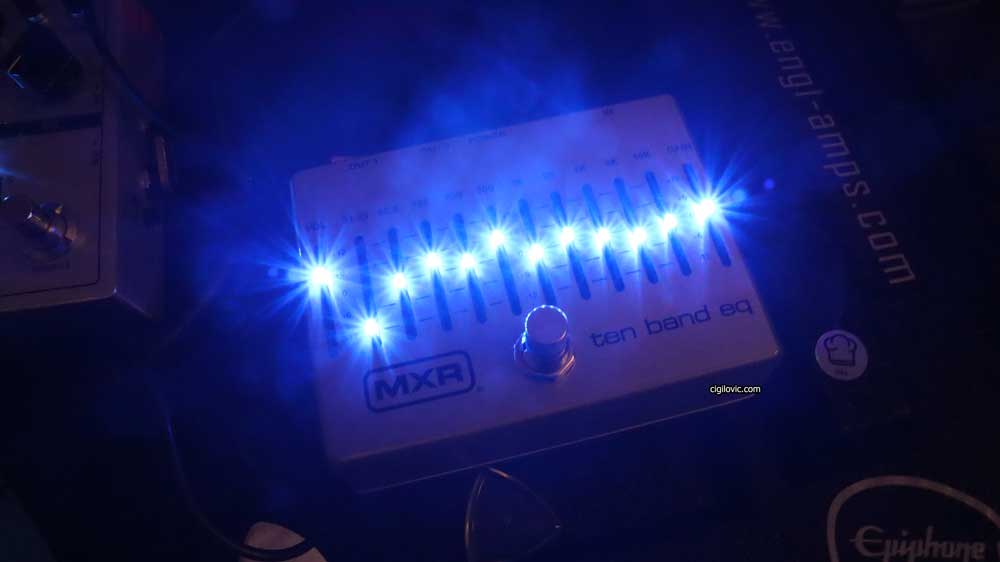
My eyes are sore every time I look at my pedal. One can suggest that it’s a set-and-forget pedal, but at the same time, it gives you a massive amount of tone-shaping possibilities, and you need to sit down and spend time with it. In other words, you have to look at your pedal constantly! Fortunately, there are a couple of quick and not-so-quick methods to replace the LEDs on the MXR 10 Band EQ. I recently purchased a dimmer, red colour LEDs and already replaced them.
Only fools keep their cash in a bank account! Let your money work for you with the most trustworthy broker ever!

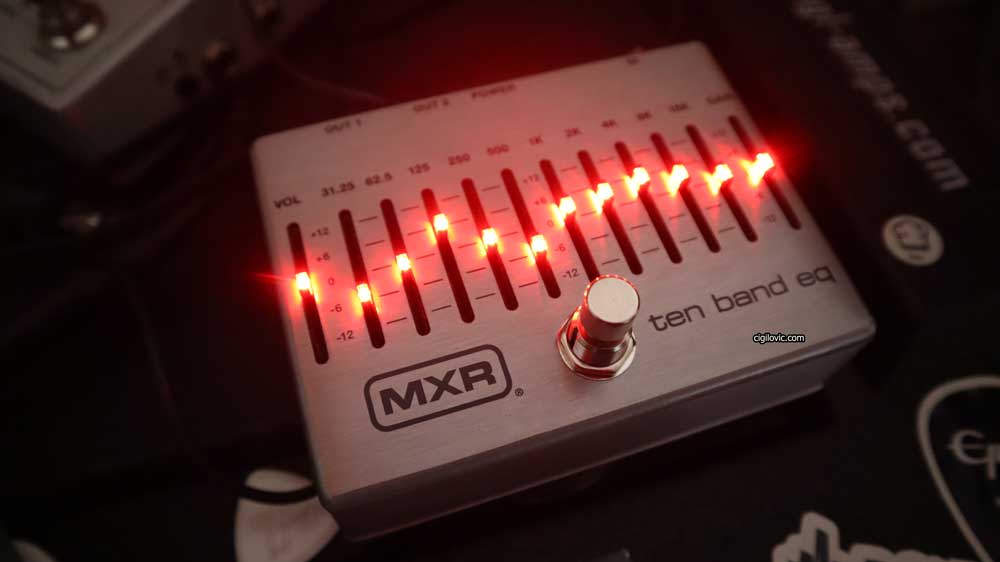
LED Mod
Even though it’s extremely annoying and, in my opinion, a design failure, replacing these bright blue LEDs is a piece of cake. When it comes to solving this bright blue LED problem, you may find a variety of options online. The most obvious one is to remove all these LEDs and end up with a completely dead-looking pedal! 🙂 This is pretty practical, but you would not be able to distinguish if your pedal is on. There’s also another approach to dimming these LEDs. This method consists of getting (I believe) resistors with higher K values and simply replacing them. However, this also requires you to have the skills and tools ready. In my case, I did not want to alter the circuit as I would have to buy a soldering iron and all the essential tools to remove the existing resistors without damaging the unit. I think the easiest method to solve this problem is to simply buy dimmer LEDs and just go for it!
I bought my replacement LEDs from TME Electronic Components company, and I recommend anyone considering replacing the LEDs on the MXR 10 Band EQ. My package arrived instantly, and the overall cost was 7-8 EUR.
To remove the blue LEDs, you need a pair of tweezers or similar tools. I used the pliers that I got from Lidl. 🙂 You also need to cut the legs of the replacement LEDs, as they feature pretty long legs. The only thing you need to be careful with is to place the longer leg facing the footswitch direction, and also not to attempt any operation when the unit is connected to a power supply.
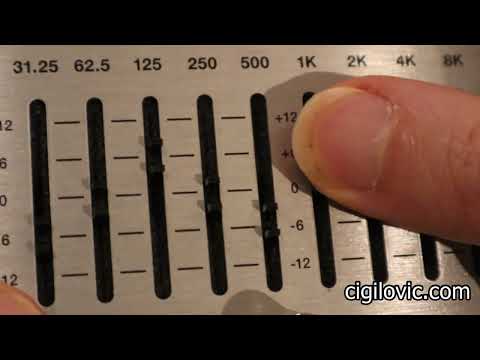
LED Replacement Video
I recorded the whole thing in a video and wanted to also share it with you. Please pay attention to the comparison section at the end, and you will see how bright these blue LEDs were!
Sound Demo (no talking)
As I mentioned, talking about how an EQ pedal sounds all day long does not make sense to me, as you will have different results with different guitars, amps, speakers or IRs. So instead, I just prepared a brief video to show you my favourite setting. I use my MXR 10 Band EQ in the FX loop of my ENGL E570 tube preamp and simply control the FX loop switch with my ENGL Z12 MIDI controller. I used my Ibanez AR300, Ibanez RG565 and Ibanez Tube Screamer Mini and recorded directly using OwnHammer IRs (Fender Twin and Marshall 1960).

Verdict
In my opinion, it makes my setup and guitars sound way better without adding any noise. In combination with carefully selected impulse responses, I can get a lot of different sounds using my current setup. For those who are seeking new gear to get the tone that they think they don’t have now, I say just stop for a while and consider getting an MXR 10 Band EQ. It not only sounds great but also cures one’s G.A.S. for good! 🙂 As EQ pedals, whether graphic or parametric, might look very intimidating at first, it’s actually not so difficult to use them. The first rule of the EQ pedals is that you don’t have to use all the sliders, adjust all the bands or use all the knobs to really make your purchase worth it! 🙂
Sometimes, a little bit of adjustment here and there will solve your problem, and you should just stop there. I tend to fall for this trap when I try multiple EQ pedals, and want to use all the knobs and sliders as I have paid for them! 🙂 But in reality, EQ pedals are just there to solve a problem that you identify. If your guitar tone needs a slight adjustment that you have identified already, you may use an EQ and just apply changes to the problematic area. 
Believe me, so far I have experienced three very different EQ pedals. One being the MXR 10 Band EQ, which features 10 bands, as the name suggests, Empress Effects ParaEQ MKII Deluxe, which is a parametric EQ with a built-in boost, and recently Ibanez Pentatone EQ, which has the best of both worlds, allowing you adjust Qs and frequencies with knobs to influence 5 band graphical EQ section (reviews are coming soon!). I observed myself while using these pedals, and regardless of the pedals, I always wanted to utilise all the features. Then I have learnt not to do so, and stepped back when I needed to.
Pricing & Availability
Luckily, like most of the MXR product line, the MXR 10 Band EQ is widely available at any music shop and basically at any store! I got mine from Thomann as usual. But as I said, you will be able to find this pedal anywhere. Note that when I got mine from Thomann, it was listed around €200, but they gradually lowered the prices for the EQ pedal. As I mentioned above, I find the price tag a bit too much for a Chinese-made EQ pedal.
Check out MXR 10 Band EQ on Thomann here
You can also check out your local marketplace on Facebook, eBay or any other local websites specific to your location for the used ones, as well as Reverb.com. It’s not always easy to find used ones for a good price, as it’s very easy to buy a brand new one at an affordable price tag.
Check out MXR 10 Band EQ on Reverb here
Also, don’t forget to check out Amazon stores, as there are resellers there in almost any location.
Check out MXR 10 Band EQ on Amazon here
I hope you find this article honest and insightful! Thanks for visiting my blog and supporting me so far! I will hopefully see you in the next review here!