- Extremely unique, 6-string, short scale bass guitar
- Very easy to play as a guitar player
- Comes with EMG pickups and an active circuit
- Offers endless variety of sounds
- Extremely lightweight
- Volume pot developed an unfixable corrosion
- It's very difficult to supply this anymore as it was discontinued
Hello there, back again with another real review of a pretty unique instrument! This time we will be looking at one of my recent purchases: an Ibanez SRC6 review!
Table of Contents
Ibanez SRC6 got my attention for the first time in late 2016 as I had become very interested in extended-range guitars such as 7-string and also baritone guitars. Featuring a 6-string, short-scale design with standard guitar tuning and way thicker strings, I thought I found a gem! A couple of years later, I moved to Bratislava and started looking for it again. However, by the time I was ready to buy it, it was discontinued! I wasn’t hopeful, but I tried searching for it online. Luckily, I found one and went for it!
Before I bought it, I did a lot of research because I wanted to believe it was closer to a guitar than a bass. But most people who own this instrument make it clear that the Ibanez SRC6 is a bass guitar! So before we dive into details about the instrument, I also want to let everyone know that this is a bass guitar! According to the Ibanez website, it was designed within an Ibanez Bass Workshop (from concept to reality). So this is basically an attempt to design and manufacture hybrid and innovative bass guitars!
Check out the Ibanez bass guitars line!
However, this doesn’t mean you can not use it like a guitar. As I have mentioned, it’s a 6-string instrument tuned to standard guitar tuning (one octave down). While I was buying this instrument at Muziker, the salesperson actually thought this was a 6-string standard guitar and started tuning it to the exact pitches of E-A-D-G-B-E notes!!! I had to stop him as this would mess up everything. 🙂
About Ibanez
As many of you know, Ibanez is a legendary Japanese manufacturer of musical instruments, primarily guitars and basses, as well as amplifiers and other accessories. Unlike many of us realise, Ibanez has a long history of making musical instruments and is possibly a much longer-established company than many of us think. Ibanez‘s history can be easily traced back to 1908, when Hoshino Gakki, a Japanese musical instrument company, was founded. In their early days, they would import Spanish guitars only. But also had a long-term ambition in the guitar business. The Ibanez brand name was derived from the name of the Spanish luthier Salvador Ibanez, who built guitars for the company. The company first used the Ibanez Salvador name and later just branded itself under the Ibanez brand to honour the Spanish luthier.
As Ibanez was getting a lot of attention for their extremely valuable guitars (lawsuit era), Gibson brought suit against Ibanez due to their clone guitars. Hoshino Gakki did not really want to fight against it, as the company could be in the same situation, not just with Gibson but also with other guitar manufacturers. This era was the triggering moment for Ibanez to take a look at the company’s long-term ambition in the guitar business.
Through the 70s, Ibanez worked with various artists who featured Ibanez’s original designs, such as Paul Stanley, Steve Miller, George Benson and Bob Weir. However, moving forward with the 80s shredders era, they still had issues with their brand identity. Actually, what Ibanez wanted was someone like Eddie Van Halen and what he did for the Kramer brand. Ibanez had already worked with legendary guitar players such as Lee Ritenour, Joe Pass, Steve Lukather and Alan Holdsworth, but the company was missing a rockstar image that could boost the brand’s identity. After having long discussions and meetings, they decided to go to Steve Vai! Vai was already getting a lot of attention when he joined Frank Zappa at the age of 20 years old. Later, he replaced Yngwie Malmsteen in Alcatrazz and also released his debut album. Around 1985, he joined David Lee Roth’s band, taking giant steps into the rock music scene already. 
Vai was already cooperating with other guitar brands such as Kramer and Yamaha, but his customisation needs were usually neglected, and he ended up with pretty much the same standard models that these companies manufactured with some tweaks for him. Ibanez eventually managed to contact Steve Vai and got his attention and their cooperation, which changed the guitar designs profoundly. Legendary luthier Mace Bailey at Ibanez made prototypes for Steve Vai based on his input and came up with the JEM design, which would later give birth to the legendary RG series. This collaboration made Ibanez so successful and gained huge respect and following in the guitar community in the 80s to this day. Although the RG model was considered the edgy, modern and unusual guitar design back in the day, it’s accepted as a classic electric guitar design that has its own place next to Strats and Les Pauls. Today, Ibanez is still manufacturing dozens of models along with their classic line and is one of the most respected guitar brands ever known to us.
Ibanez SRC6 Crossover Short-Scale Bass Guitar
Ibanez SRC6 features a jatoba body. It comes without any finish or lacquer, with very lightweight and resonant wood that complements EMG 35Hz pickups. I have just inspected mine and been able to count 4 pieces! There are 3 big pieces plus a small piece that I can spot around the pots.
Mine is made in 2018, in Indonesia. I must say the craftsmanship is flawless! There was not a single problem out of the box. As for the body, Ibanez doesn’t mention the number of pieces, but they clearly state the number of pieces on the neck. It has 5 pieces in total, consisting of jatoba and reinforcing walnut strips.
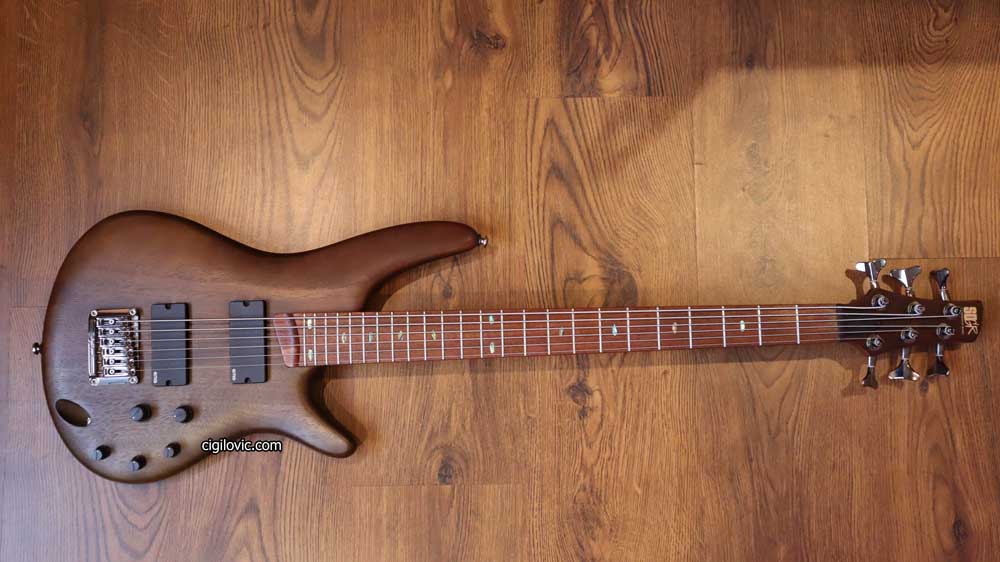
Ibanez SRC6 also features a pair of EMG 35Hz pickups. Unlike the first thing that comes to one’s mind about EMG being all about active pickups, this pair of pickups is passive! However, the guitar comes with active Ibanez custom electronics featuring a master volume, a blend pot that enables you to blend bridge and neck pickups precisely and also 3 pots as bass, mid and treble controls. Soundwise, these custom electronics offer a huge variety of different sounds.
Cool bit of information about Ibanez! Did you know that you can find detailed information about every single component and parts used on Ibanez guitars and basses here on this page?

Let me first share the very first video that I released using my Ibanez SRC6. I played a timeless song by Barış Manço & Kurtalan Ekspres – Dönence, which has one of the sweetest bass lines out there!
Dönence Bass Guitar Cover featuring Ibanez SRC6

Before I give you more about my opinions on the instrument as well as some critical “upgrades“, here are the tech specs of the Ibanez SRC6 below.
Tech Specs
| Ibanez SRC6 | Tech Specs |
|---|---|
| Neck Type | SRC6 5 piece Jatoba/Walnut Neck (Bolt-on, 4 bolts) |
| Body | Okoume Body |
| Fretboard | Jatoba Fretboard Abalone Oval Inlay |
| Frets | Medium Frets |
| Number Of Frets | 24 |
| Scale Length | 30" - 762mm |
| Bridge | Tight-End Bridge |
| String Space | 10.8mm |
| Neck Pickup | Emg® 35Hz Neck Pickup (Passive) |
| Bridge Pickup | Emg® 35Hz Bridge Pickup (Passive) |
| Equaliser | Ibanez Custom Electronics 3-Band Eq |
| Factory Tuning | E- A-D-G-B-E |
| Strings | D'Addario® EXL156 |
| String Gauge | 24-34-44-56-72-84 |
| Nut | Plastic |
| Nut Width | 42mm (58mm at 24th Fret) |
| Hardware Color | Cosmo Black |

Sound Demo (no talking)
As I have been updating my content to provide more recent, relevant materials for you, I also noticed that I missed adding the video here! 🙂 I was actually trying to feature the EMG 35HZ pickup on this bass guitar, and ended up just producing this below with my more recent gear. In this video, I used my SRC6 along with IK Multimedia Amplitube 5 (for the clean parts), Marshall JVM410H tube amp and RedSeven Amp Central reactive load for the high-gain parts. The strings were Ernie Ball 2837.

Review
As this is a bass guitar, I have to confess that I won’t be able to go into all the details that a bass player would pay attention to. However, I’ll do my best to go through each main part and section of this instrument.
Headstock
SRC6 features a classic SDGR-style headstock. For those who don’t know what this is, it’s actually the series Ibanez places many of their bass guitars under. Although most people think this is a recent series name, it actually was born in 1987! 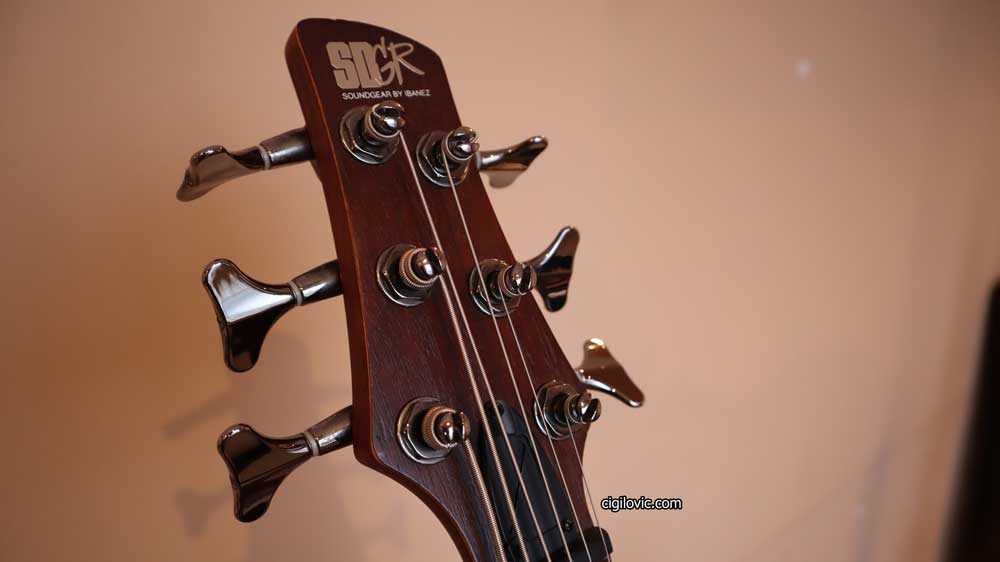
Tuners
It features 6 Soundgear tuners in the Cosmo Black colour option. As you can see from the images, these are pretty classic tuners with a top-loading, vintage-style design. On the back, you can also see that nothing fancy is going on here. These are not locking tuners.
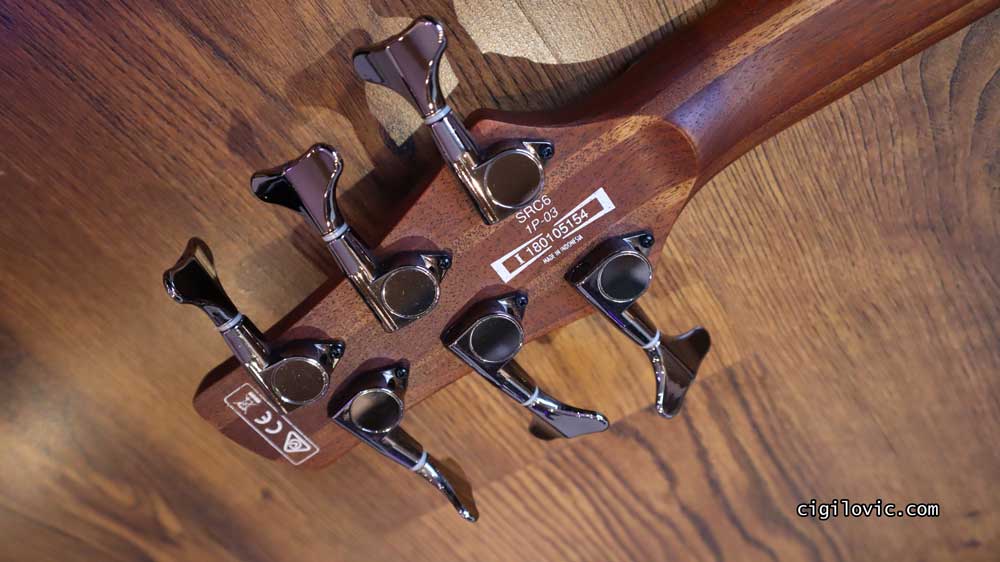
On the back of the headstock, you have the serial number. Mine has #I180105194, clearly indicating a made-in-Indonesia instrument. Regarding the Cosmo Black finish on the tuners as well as on the hardware: In my opinion, even though these look great, I must say I don’t like this finish. It’s prone to cracking and a complete fingerprint magnet! 
Neck
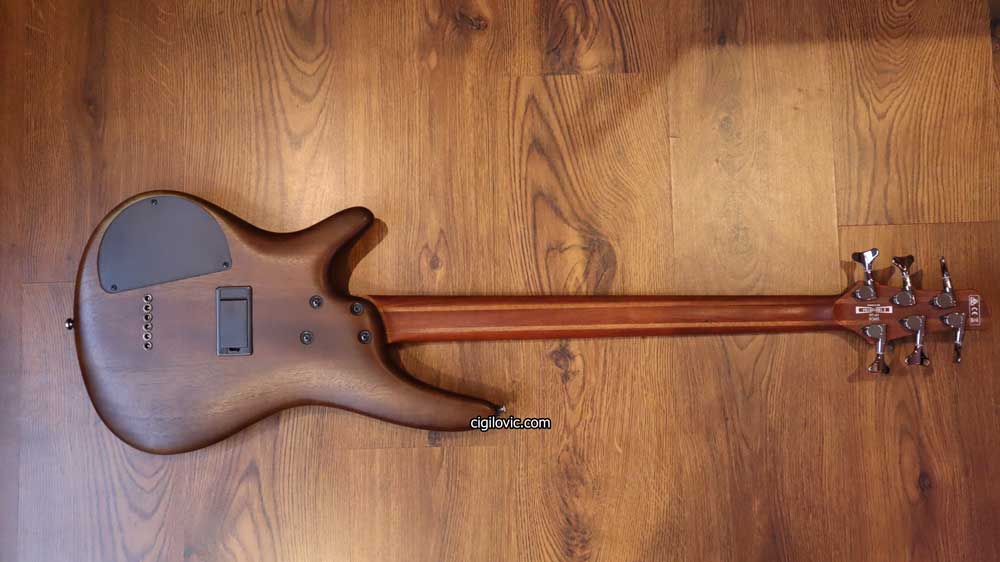
As briefly mentioned above, the neck on the SRC6 features a 5-piece Jatoba/Walnut Neck (Bolt-on, 4 bolts). The neck is extremely comfortable, but comes with a neck dive!
Fretboard
Ibanez uses the Jatoba wood on the fingerboard as well. To be honest, this was my first time experiencing this wood on the neck and the fretboard. I wasn’t expecting to like this, but I ended up liking it. Although it looks like a cheap alternative to rosewood (please note that these guitars were manufactured during the CITES era), it sounds and feels pretty good!
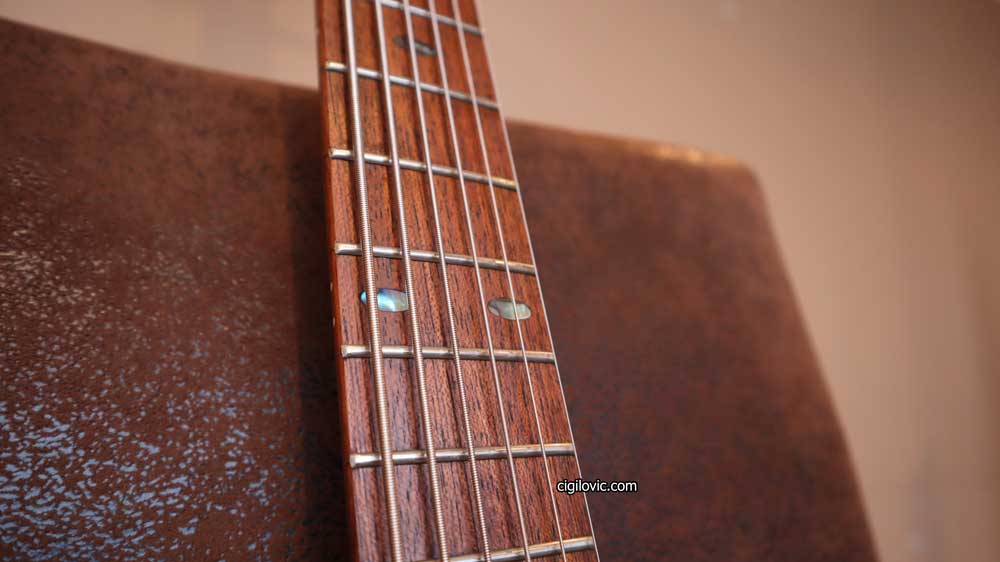
This fingerboard comes with 24 frets. According to Ibanez, these are medium frets. But that’s the only information we have. I believe it’s just standard-quality fret wires. The fretwork was pretty spot on for such an instrument. I couldn’t spot any problematic areas. However, as with many Indonesian-made guitars, the frets needed a bit of polishing.
Body
The body is made of okoume, which is an alternative body wood used on basses and guitars in recent years. As supplying mahogany gets more expensive, manufacturers have started using okoume on the bodies of various instruments. Okoume is a pretty lightweight alternative, so I must say I was very surprised when I first grabbed this instrument in a shop.
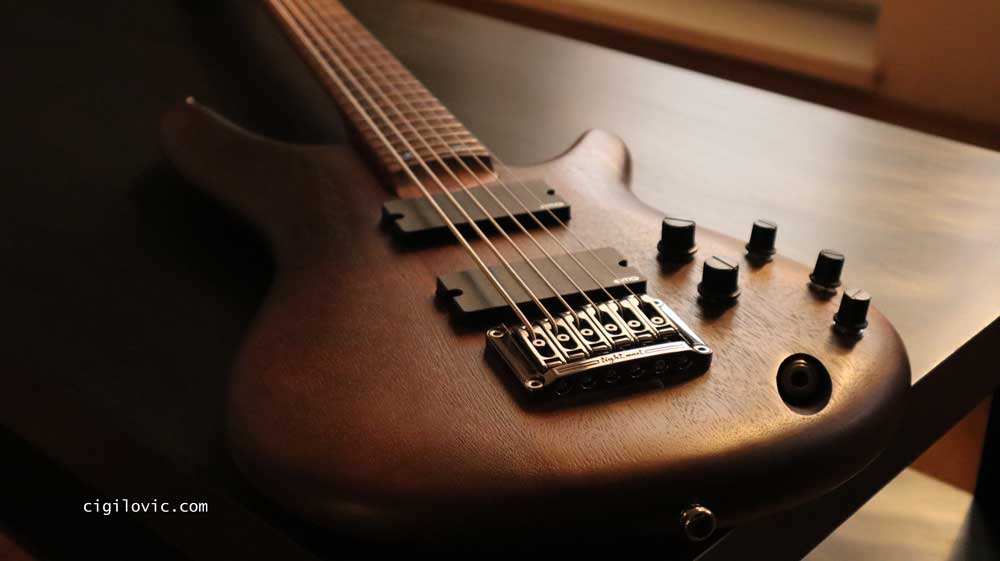
Mine has 3 big and 1 small piece glued together. Since the body is pretty light and the neck is pretty long due to the fact that it features a full 24 frets, there is a significant neck dive on this instrument. As I have mentioned, jatoba tonewood is very lightweight and resonant on this guitar. So lightweight that it is actually a bit unbalanced. In my opinion, this guitar is not made for playing without a strap. For me, it was really challenging to handle it without a strap, as the neck tends to pull the body to your left.
Pickups & Electronics
SRC6 comes with a pair of EMG 35HZ pickups. Although these pickups are EMG-branded and look like active pickups, they are not! 🙂 These are passive pickups, but the guitar also features an active preamp circuit. As you can hear from the video above, you can get tons of different sounds out of these pickups, thanks to the active preamp circuit with 3-band EQ!
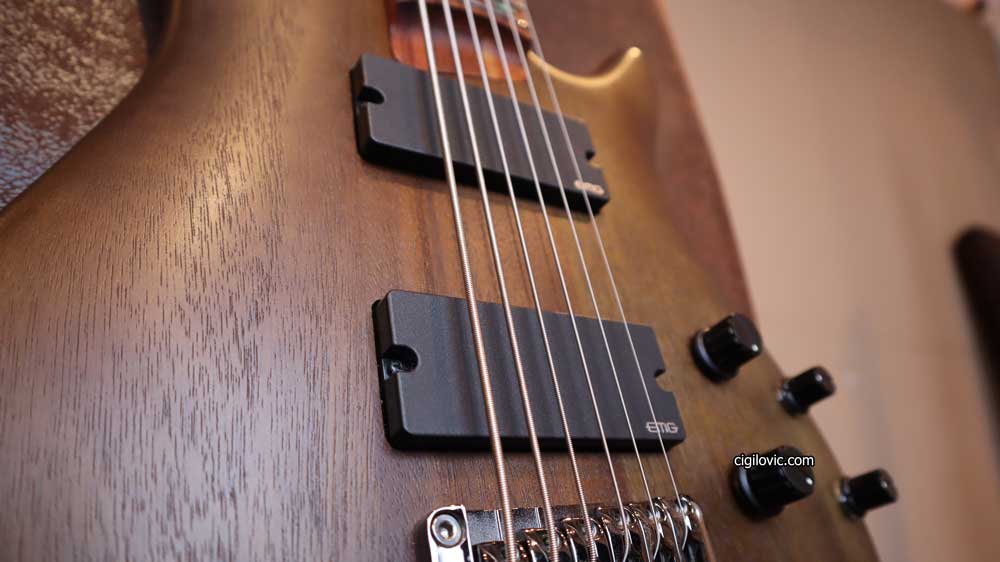
You can actually blend two pickups as you wish and also boost or cut high, mid and low frequencies. As this instrument sits almost in between electric and bass guitars (but it’s still a bass guitar!), you can really get huge distorted sounds without any problem. Mind you, it will never feel like a guitar! 🙂
This was actually something I learnt from owning SRC6 as well as owning my lovely Schecter Hellraiser Hybrid PT-7. The Schecter is a 26.5″ scale, 7-string guitar, while the Ibanez SRC6 is a 30″, 6-string short-scale bass guitar. While experimenting with the Schecter, I realised that the low E did not feel and sound like a low E on a standard guitar, because the scale length was different. I tried to solve that by testing thicker strings overall, but this time, the guitar had started to feel like a short-scale bass guitar!
Only fools keep their cash in a bank account! Let your money work for you with the most trustworthy broker ever!

This experiment helped me understand my preferences better, because now I know that I’m not really into 26.5 or 27″ 7-string guitars but rather into a standard-scale 7-string guitar. When it comes to the electronics of the SRC6, I first had a good impression and a pretty nice experience with the active circuit. I had no problems whatsoever. However, after some time, the pot used for balancing the pickups started acting really weird. I tried cleaning the corroded pot with DeOxit, but it didn’t really help. And unfortunately, this turned out even worse after I sold this instrument. I had to do a partial refund to the buyer to keep this fair.
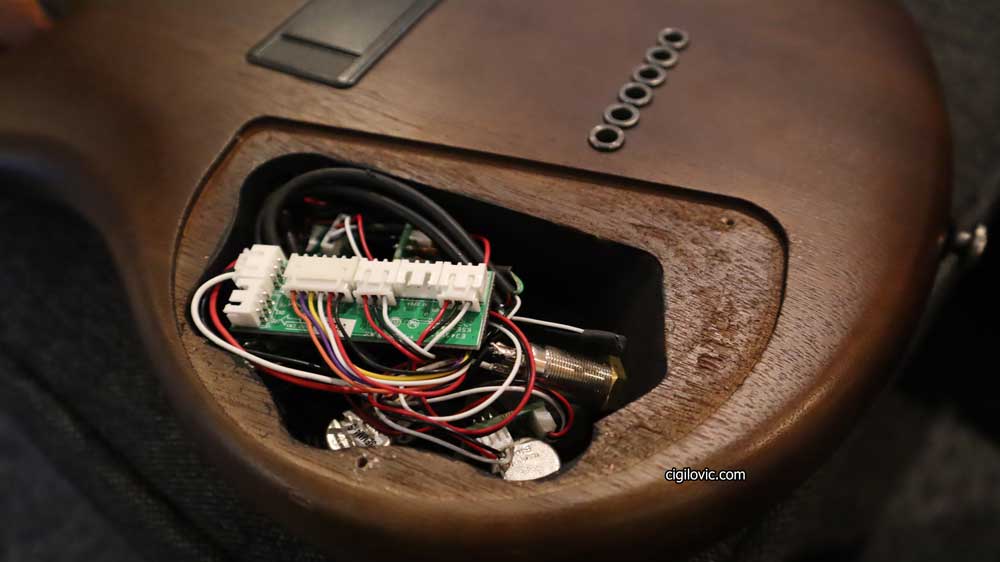
As you can see from the image above, it has a pretty clogged structure in there. Lots of cables, connectors and a PCB! I know this instrument is aimed at bass guitar players rather than guitar players, but I’d much prefer it if Ibanez just simply put a volume, tone and a 3-way switch just like on electric guitars.
Bridge
Ibanez SRC6 features an Ibanez Tight-End bridge, which they use on many of the basses and guitars. The bridge was overall pretty good, but the Cosmo Black finish was a bit problematic. It tends to crack easily on the surface and looks pretty bad even though there’s nothing wrong with the functionality.
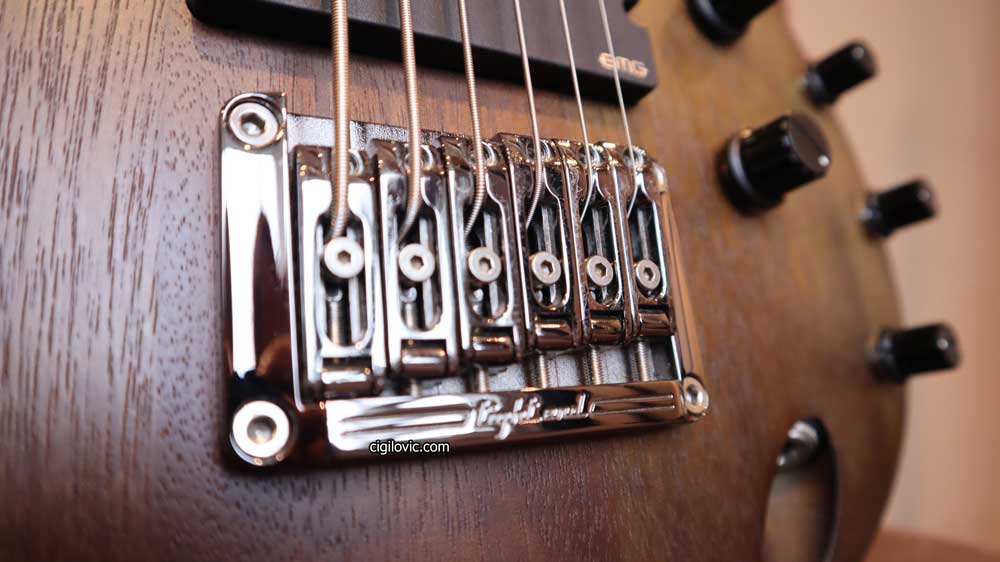
Overall, the Ibanez SRC6 was a joy to play, and I must say one of the most unique and experimental instruments I have ever tried. There’s another point I’d like to make regarding the factory strings. As mentioned, it comes with a set of D’Addario® EXL156, and in my opinion, these feel a bit sloppy and loose.
As you probably know, when we have longer scales on guitars/basses, there may be problems regarding string tension at recommended tunings. Except for the low E string, every single string sounds really nice and balanced. Especially when you play near the octave and higher on the low E string (starts around the 9th or 10th fret), it produced some ringing sounds. It was almost like those notes and the top part of the frets were causing a resonance problem, which I wasn’t able to solve with the adjustments.
Ernie Ball 2837 Slinky Baritone Good Fit For Ibanez SRC6?
So in order to fix this issue, I started researching alternative string brands and gauges. I ended up finding some good customer reviews on Ernie Ball 2837 Slinky strings that were claimed to go really well with Ibanez SRC6. But there was a concern mentioned by many users. They basically bought Ernie Ball 2837 and attempted to restring their 6-string, short-scale basses from companies such as Squier by Fender Classic Vibe Bass VI.
Some of the 6-string short-scale basses feature a tremolo and also a longer headstock, which makes it impossible for strings to reach that far. This means they weren’t able to string their guitars with this set. But there was a really helpful customer on one of the websites, and he clearly stated that Ernie Ball 2837 strings are a great fit for the Ibanez SRC6.
I even contacted Ernie Ball and Ibanez on Twitter; however, they were never sure about it, as Ernie Ball wouldn’t take responsibility for another guitar manufacturer’s products and Ibanez would do the same. So it turned into a ping-pong game! 🙂 There was nothing but risk for me to take! So I got myself a set of Ernie Ball 2837 Slinky strings. Fortunately, it just fit right! And more importantly, these rattling, ringing sounds disappeared immediately!
Ernie Ball 2837 Slinky strings are a set of 6 strings for baritone instruments. The string gauges are as follows: 20-30-42-54-74-90 as opposed to D’Addario® EXL156 24-34-44-56-72-84.
As you can see, except for the low E and A strings, the rest of them are thinner in gauge with Ernie Ball. But the low E and A strings are a bit thicker! That does the miracle in my opinion and just adjusts the balance and tension at the optimum level. Recently I got another set of Ernie Ball 2837 and this time published a review of this string set. Please have a look, especially if you play a short-scale, 6-string bass guitar.
Check out my Ernie Ball 2837 Slinky review here
Verdict
To summarise, I think Ibanez SRC6 is an excellent instrument. But don’t take it as an extended range GUITAR, it’s just a short-scale, 6-string bass guitar featuring a standard guitar tuning and guitar-like string spacing. This means it is going to feel more like a guitar than a bass! This is why it’s called a crossover 🙂
The active EQ circuit gives you a lot of tonal options, and I think you can use this guitar/bass in many musical situations. I wish Ibanez had used a little better components, as it wasn’t the cheapest to buy this instrument. If you are into experimental bass/guitar hybrids, you should definitely check out this instrument. It may be very inspirational for some musicians.

Pricing & Availability
Unfortunately, it’s discontinued and almost impossible to find online, so your best bet is to search for these on Reverb.com occasionally. It’s definitely a keeper and so much fun to play thicker, bass sounds while having a guitar-playing feel; you should try one! Ibanez also released a new iteration of this hybrid instrument, this time with a multi-scale design, so you may want to check that out too!
Check out Ibanez SRC6MS on Thomann here
Here on Reverb, there are both SRC6 (used) and SRC6 multi-scale versions listed.
Check out Ibanez SRC6 on Reverb here
You may also want to check out Amazon for the multi-scale version.
Check out Ibanez SRC6MS on Amazon here
Thanks for visiting my blog and supporting me so far! I will hopefully see you in the next review here!