- Extremely affordable, beginner-friendly LP-style guitar
- Authentic design with cost-cutting specs
- Pretty stable and consistent quality for the money
- It might not be the most authentic LP-style guitar experience (e.g. bolt-on design)
Hello there, back again with another entry-level guitar. This time we will be looking at the Epiphone Les Paul 100 electric guitar. If you are into Les Paul-type, single-cut guitars (like me!) and want to get started without busting your budget, you should always consider one from the Epiphone brand. As you might know, Epiphone is known for its long history in guitar manufacturing, which goes back to 1873, and it was acquired by Gibson and considered to be in the Gibson family since then. Plus, it’s the only company that can license a Gibson design other than Gibson. 🙂
Table of Contents
Every guitar player knows that if you can not afford a Gibson, which is very understandable, you can always go for Epiphone models, which have great product segmentation and excellent instruments.
Please consider supporting this blog by buying your gear from Thomann using my links at no extra cost to you, many thanks!

About Epiphone
For those who have never heard of Epiphone, here’s a quick introduction! Epiphone is a well-known guitar manufacturing company that traces its origins back to the late 19th century. The company was established in 1873 by Anastasios Stathopoulos in Smyrna, Ottoman Empire (now Izmir, Turkey – interestingly, this is my hometown! :)). Initially, Epiphone focused on making traditional Greek instruments, but it eventually shifted its focus to guitars. In the early 20th century, the company moved to the United States and gained a reputation for producing high-quality, affordable guitars. Epiphone guitars became popular among musicians for their craftsmanship and sound. Over the years, Epiphone has manufactured a wide range of guitar models, including archtops, solid bodies, and semi-hollow bodies. 
One notable aspect of Epiphone‘s history is its association with Gibson, another prominent guitar manufacturer. Gibson acquired Epiphone in 1957, and since then, Epiphone has operated as a subsidiary of Gibson. This collaboration has allowed Epiphone to benefit from Gibson’s expertise and technology while maintaining its distinct identity. 
Musicians across various genres widely use Epiphone guitars, and the brand is known for offering instruments that provide good value for their price. The company continues to produce a diverse range of guitars, catering to the needs of both beginners and experienced players. Epiphone guitars are recognised for their versatility, making them a popular choice in the music industry. Epiphone was always one of my favourite brands while I was working in the musical instruments industry. Even their most affordable guitars would sound and play great, almost right out of the box.
Check out my Epiphone guitar reviews
With the extremely high level of competition in the musical instrument industry, guitar brands have been putting so much effort into improving the quality of entry- and mid-segment guitars. Recently, Epiphone has also put a lot of effort into making really cool guitars under their “Inspired by Gibson” series. This means that the Epiphone company (owned by Gibson) releases Les Pauls and SGs, which are almost exact replicas of the original legendary models with some step-back features. 
All I remember about Epiphone during my service in the musical instruments industry was that we always sold entry-level models like hotcakes, and there were not really serious problems out of the factory, which means the quality control is always top-notch. In this review, you will be hearing the Epiphone LP 100 electric guitar with different setups. I was able to find three videos that I played in. Let’s start with the shorter ones first (the in-video title says it’s a cherry burst, a small editing mistake!). We used a Marshall MG15C combo amp, and it was just recorded with a Rode VideoMic Pro.
Sound Demo (no talking)

Let’s have a look at the tech specs first;
Only fools keep their cash in a bank account! Let your money work for you with the most trustworthy broker ever!

Tech Specs
| Epiphone Les Paul 100 | Tech Specs |
|---|---|
| Construction | Bolt-on, Tapered Heel, 4 Bolt Recessed |
| Body | Mahogany |
| Fretboard | Okoume* |
| Nut Width | 42.67mm |
| Neck | Maple Neck |
| Radius | 304.8mm |
| Frets | 22 Medium Jumbo Frets |
| Pickups | 700T Humbucker (Bridge), 650R Humbucker (Neck) |
| Bridge | Tune-O-Matic Bridge |
| Tuners | Die-cast Tuners |
| Finishes | Ebony (EB), Heritage Cherry Sunburst (HS), Vintage Sunburst (VS) |
| Strings | D'addario 10-46 |
| Typical Weight | Around 3.5 - 3.7kg |
Before I talk about the specs, let’s hear it with another short video, this time using the bridge pickup only.

As for the specs, you’ll see some * mark that needs an explanation. I actually don’t remember that they would use okoume wood on the fretboard. I believe it’s a Post-CITES thing. But depending on which stock you are buying from, you might have rosewood or okoume wood on the fretboard.
But for the level of this guitar, you don’t need to worry too much about these. This Epiphone Les Paul 100 review video was recorded with a Marshall JVM205C valve amp + Shure SM57 microphone.
Sound Demo (no talking)
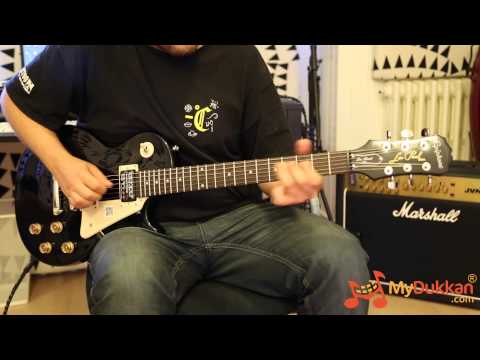
This was one of our first videos in the series. The lighting was giving this first series a yellowish tone, and I tried my best to play after a long break from playing. Hope you like it; it’s a non-biased approach, as you can see. No talking, just playing with the same amp settings and different pickup combinations + amp channels and modes to give you the most honest sounds. As I mentioned, this is the go-to model if you are into Les Pauls but can not afford a real Gibson one. It’s 99.5% of the time ready to play out of the box. Actually, if you are OK with owning an Epiphone Les Paul guitar, you should definitely check other models of the brand. 
Pricing & Availability
As I mentioned, the Epi Les Paul 100 was long discontinued, and the vibe and the spec set of these were transferred to other entry-level series in the Epiphone line. Just like the LP Special II, the closest spec set and vibe can be found on the Epiphone Les Paul Tribute series. This happened due to the CITES regulations that hit the guitar manufacturers, as well as due to product segmentation that the companies implement.
Just as an example, Gibson would have Gibson LP/SG Tribute models, which were the bare-bones, affordable but still made-in-the-USA guitars. Currently, the price ranges that these guitars would occupy are now covered by Epiphone’s higher-end guitars, which would even cost more than made-in-the-USA, bare-bones models (I find it pretty annoying, to be honest!). So, if you are looking for the Epiphone Les Paul 100’s current replacement, your best bet is to go for the Epiphone Les Paul Tribute models.
Check out Epiphone Les Paul Tribute on Thomann here
You may also want to check out Reverb if you still want to chase the Epiphone Les Paul Special II model guitars.
Check out Epiphone Les Paul 100 on Reverb here
Hope this has been a helpful review for you to choose your beginner LP-style electric guitar, and I highly recommend you consider the Epiphone Les Paul Tribute (or the used LP 100) model guitars. These guitars were the money makers for any music store back in the day and sold regularly all year round.
Thanks for visiting my blog and supporting me so far! I will hopefully see you in the next review here!