
Hello there, and welcome back to yet another great article! This time, we will be looking at a legendary tube guitar preamp that is often overlooked and goes unnoticed! Mesa Boogie Rectifier Recording Preamp! In this article, I will provide you with some fundamental information, as well as a no-talking demo video that I have prepared specifically for this article. As many of you already know, from the 80s to almost the 2000s, all-tube guitar preamps were on the rise and very popular among guitar players. However, with the introduction of guitar amp simulation software and processors, they lost a big share of the market and slowly disappeared.
Table of Contents
There are still guitar players out there who have a keen interest in these legendary tube preamps and are seeking them in the used market. As I am also very interested in preamps, I can’t help but regularly check out the used market for used tube guitar preamps. If you are a regular visitor, you probably know that I published a Mesa Boogie TriAxis review article back in the day. I also released multiple demo videos featuring the products, as well as comparing the TriAxis against software versions available in the market.
However, I was also craving for a Rectifier Recording preamp and finally found one. I traded my TriAxis with the Rectifier Recording Preamp just to experience this legendary preamp circuit and feature it on my blog here for you! Before I start diving into details, let’s first have a quick look at the history of the Mesa Boogie company.
About Mesa Boogie
Mesa Boogie is a legendary name in the world of guitar amplification, renowned for crafting amps and preamps that have defined the tone of entire eras of music. From the early days of boutique amp innovation to the heavy-hitting sounds of modern rock and metal, Mesa Boogie has consistently set the standard for tonal excellence and versatility.
With a product lineup that includes the groundbreaking Mark series, the genre-defining Dual Rectifier, and highly sought-after preamps such as Studio, Quad, TriAxis and Rectifier Recording Preamp, Mesa Boogie continues to be a cornerstone for musicians seeking world-class sound. In the late 1960s, the mastermind behind the Boogie, Randall Smith, began modifying Fender Princeton amplifiers in his Petaluma, California, shop. These “hot-rodded” Princetons featured higher gain and richer distortion, capturing the attention of top-tier guitarists. Carlos Santana famously described his experience with one of Smith’s amps as, “Man, this thing boogies!“, a phrase that inspired the company’s name.
The 1970s: The Mark I
Mesa Boogie entered the spotlight in 1971 with the release of the Mark I amplifier. It was revolutionary, featuring cascading gain stages that allowed guitarists to achieve creamy sustain and high-gain tones previously unavailable in other amps. The Mark I became a favourite of artists like Santana and The Rolling Stones, offering a compact design without sacrificing power or tonal clarity.
Check out the entire Mesa Boogie catalogue on Thomann here
The 1980s: The Mark II and Studio Preamps
The 1980s saw the debut of the Mark II series, which introduced innovations like channel switching, allowing players to switch between clean and overdriven sounds seamlessly. The Mark IIC+, a standout model from this era, became legendary for its tight, aggressive tone, used by Metallica on their seminal album Master of Puppets. During this time, Mesa Boogie also ventured into standalone preamps, such as the Studio Preamp and Quad Preamp, which offered players studio-grade tone shaping and versatility. These products became staples for guitarists seeking high-quality sounds for both live and recording environments. 
The 1990s: The Rectifier Revolution
In 1991, Mesa Boogie released the Dual Rectifier, a game-changing amplifier that defined the sound of modern rock and metal. With its massive gain, tight low end, and raw aggression, the Rectifier series became the go-to amp for bands like Korn, Limp Bizkit, and Tool. The Rectifier’s impact on the sound of grunge, nu-metal, and alternative rock cannot be overstated.
The 2000s and Beyond: Versatility and Expansion
The 2000s brought further evolution with the Mark V, which consolidated the features of previous Mark models into one amplifier, and the Roadster and Road King series, offering unparalleled flexibility for touring musicians. Mesa also introduced compact models like the Mini Rectifier and California Tweed, catering to players seeking Mesa’s legendary tones in portable formats.
Legacy and Modern Era
In 2021, Mesa Boogie was acquired by Gibson, ensuring its continued legacy while maintaining its roots in Petaluma, California. Today, Mesa Boogie remains synonymous with innovation and quality, beloved by guitarists worldwide for its legendary amps, preamps, and dedication to tonal perfection. Whether it’s the iconic tones of the Mark I, the brutal attack of the Dual Rectifier, or the finesse of their preamps, Mesa Boogie has left an indelible mark on music history.
Mesa Boogie Rectifier Recording Preamp
As mentioned in the introduction, I traded my Mesa Boogie TriAxis for the Rectifier Recording preamp. Most of you may think that this is a stupid idea, as TriAxis offers way more versatility than a Rectifier preamp. However, I couldn’t resist experiencing this legendary yet overlooked preamp. Instead of putting a lot of cash into this, I offered the seller a head-to-head trade, and he accepted, as he was also looking for a TriAxis to try!
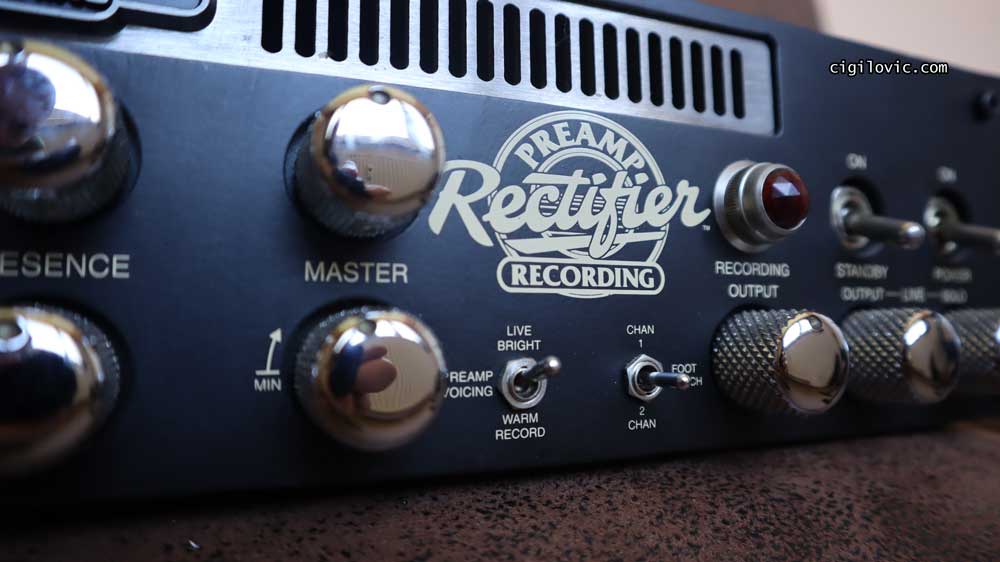
According to Boogie, they spent three years replicating the sound and the feel of their legendary Dual and Tripler Rectifiers directly to tape. You may find these claims a bit of overkill. However, if you consider the release date, which was the early 2000s, the market was not filled with authentic preamp circuits but was filled with digital units, processors and multi-effects units. 
What Mesa Boogie did was pretty groundbreaking, as it was very difficult to squeeze the sound and feel of the Recto amps into a 2U rack unit. Although many Boogie snobs look down on the Rectifier preamp, the company used the exact same parts and circuitry while building this legendary preamp! Rectifier Recording Preamp comes with 6 Mesa Boogie-branded preamp tubes, 5 custom transformers, and tons of finely tuned inductors in this small yet powerful tube preamp.

Features
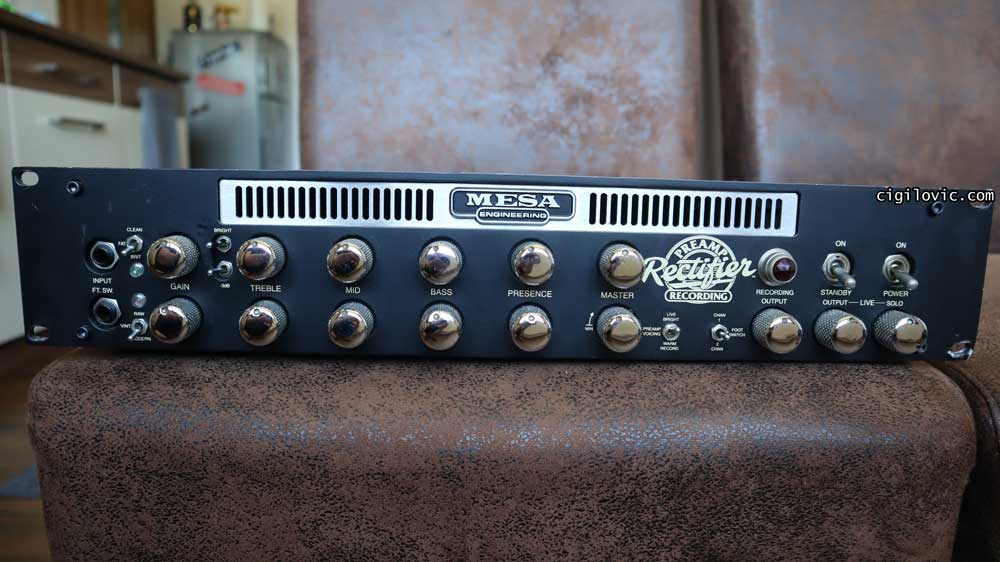
Mesa Boogie put so much effort into this preamp to make it sound and feel like the real deal Dual and Triple Rectifier amplifiers. Of course, the Rectifier Recording Preamp is just the preamp section of this legendary amp. What we have here is a dual-channel, all-tube design guitar preamp with multiple voicings on each channel.
Channel 1
This is our clean channel with three different voicings. Before we start diving into details, I must say, don’t be fooled by the name of this channel, as it can really get aggressive with the master volume cranked! On the Clean channel, we have “Clean“, “Fat” and “Brit” modes. The Clean mode offers the lowest gain among all modes and optimises for balanced, pristine clean sounds. Starting around 12:30 with gain settings, it starts adding sparkle and a little bit of edge of breakup characteristics.
Next, we have the Fat mode, which comes from the original Mark I Boogie circuit, and this mode puts emphasis on the low mid and bottom end, resulting in more grit and width for the top strings. Note that every voicing is different, and you should consider reviewing your EQ when you change voicings. Last but not least, we have the Brit mode, which is inspired by the British sound that can be found in the amps back in the 50s and 60s. According to Boogie, these British amplifiers were basically Leo Fender’s design but upside down! Instead of just copying these circuits, Boogie altered them to suit the overall Recto-vibe.
Channel 2
On Channel 2, we have three different voicings as well. First, we have the Raw mode, which offers the lowest gain on this channel. It can be set as an alternative clean channel or low-gain bluesy channel all the way up to a grinding crunch or searing solo sound. Again, the EQ is highly interactive and will add different gain characteristics to your sound. Always review your EQ settings based on the voicing you choose and the gain setting you prefer!
Next, we have the Vintage mode, which is the high-gain mode for the infamous liquid Recto DNA. It offers a huge amount of harmonic content and a fat, creamy feel, which can be heard on many recordings that feature Mesa Boogie Rectifier amplifiers! Lastly, we have the Modern mode, which offers the most amount of aggression, which is great for modern hardcore sounds. This mode comes with additional tightness and low-end response with a pronounced top end. 
Go Direct
As the name suggests, the Mesa Boogie Rectifier Recording Preamp is intended to be used in direct recording scenarios with its onboard analogue cabinet simulation. For sure, it can’t compete with the modern-day impulse responses and power amp simulations while going direct. But if you consider the era when this was released, it was groundbreaking, as with any Boogie product.
Tons of Outputs!
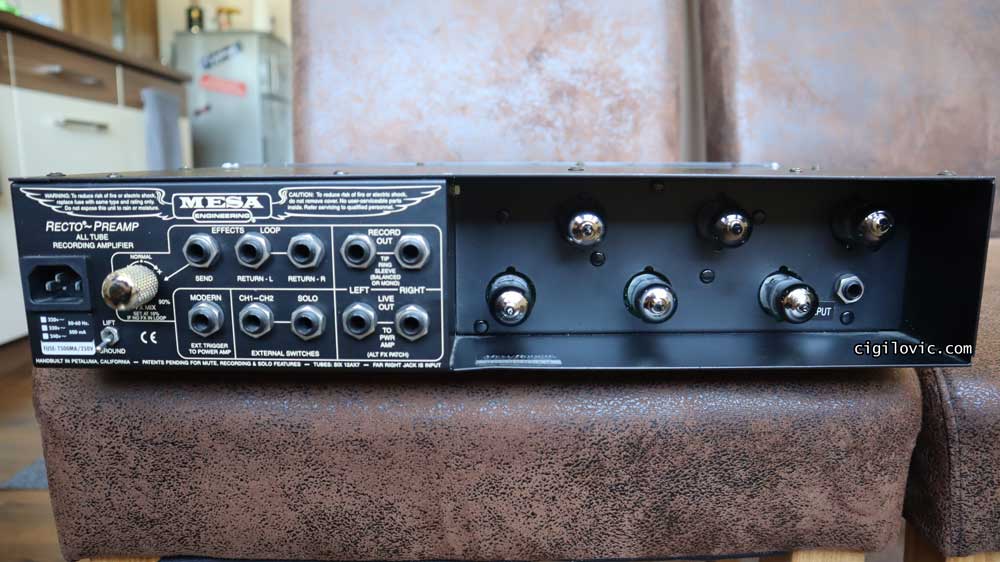
Rectifier Recording Preamp not only features a stereo record output but also a stereo FX Loop, External Switching and Smart Power Trigger that can be used with their legendary power amps live! A Parallel Effects Loop with Left/Right Returns and a Mix Control provides seamless stereo processing. The External Switch Jacks allow remote switching control to the two channels and the Solo feature via any latching tip-to-ground switch or controller. An External Trigger port is also provided to activate the Modern mode in the Rectifier Stereo Power Amp (or any Smart Power™ function on any Mesa Power Amp) to deliver fully authentic Recto mayhem.

Before we jump to the demo video and the review, let’s have a quick look at the tech specs below. 
Tech Specs
| Rectifier Recording Preamp | Tech Specs |
|---|---|
| Tubes | 6X Mesa Boogie 12AX7 |
| Channels and Modes | 2 Channels / 6 Modes |
| Mode Voicings/Styles | Ch. 1 = Clean, Fat or Brit |
| Ch. 2 = Raw, Vintage or Modern High Gain | |
| Graphic EQ / Reverb / FX / Solo | FX Loop, Solo |
| Footswitchable Functions | Ch. 1/2 & Solo |
| Cabinet Simulation - Direct Live/Recording Output | Yes |
| Weight | 7.25kg |
| Dimensions | 8.9cm x 48.25cm x 34.3cm (H X W X D) |
| Footswitch | Included |
| Available Formats | Rackmount (2 Rack Spaces) |
| Made In | Hand-Wired In Petaluma, CA with the World's Finest Materials |
| Preamp Type | Tube |
| Chassis Material | Aluminum |
| Rectifier Type | Silicon Diodes |
| Variac Power Switch | n/a |
| Preamp Tubes | 6x Mesa 12AX7 |
| Convection or Fan Cooling | Convection |
| Number of Footswitchable Channels (or Modes) | Two Channels |
| Number of Style Modes | Six |
| Number of Style Modes Per Channel | Three |
| Types of Style Modes Per Channel | Ch. 1 = Clean, Fat or Brit |
| Ch. 2 = Raw, Vintage or Modern High Gain | |
| Channel Controls | Each Channel features Independent Gain, Treble, Mid, Bass, Presence and Master - Channel 1 also features a Bright Switch & -3dB Pad Switch - Channel 2 features a Live Bright/Warm Record Voice Switch |
| Graphic EQ and/or Contour or Dynamic Voice | n/a |
| Reverb / Effects & Bypass Options | n/a |
| Effects Loop & Bypass Options | Fully Buffered Parallel FX Loop with Stereo Returns & Mix Control |
| Global Output Level Control | Yes (Over all channels - Controls the overall output to the Live Outputs (power amp), mono or stereo) |
| Global Solo Level Control | Yes (Over each channel when activated - Controls the Solo Level Output to the "Live Outputs" only) |
| Global Recording Level Control | Yes (Over all channels - Controls the overall output to the Recording Outputs only, mono or stereo) |
| Bypass Options | n/a |
| Tuner Output | n/a |
| External Switching, Triggering and/or Midi Options | External Switching Jacks for Channel 1/2 & Solo - 1 External "Smart Power™" Trigger Jack to control Smart Power Modes (Modern, Deep & 1/2 Power) on select Mesa® Power Amps |
| Outputs | 2x Live Outputs Left & Right and 2x Record Outputs Left & Right |
| Cabinet Simulation - Direct Live/Recording Output | |
| Headphone Output | n/a |
Sound Demo (no talking)
While I was craving for the Rectifier preamp, I often checked YouTube and other platforms to see a simple demo. Unfortunately, there were not many videos available, and this made me even more crave for this! 🙂 As soon as I got the preamp, I hooked it up with my current setup and recorded a simple walkthrough of the channels and the voicings. I used my Cort M600, Marshall JVM410HJS, Two Notes Torpedo Captor X, as well as my RME Babyface PRO FS audio interface and Genelec 8020DPM monitors. I only used PSP SpringBox as my reverb plugin. I connected the preamp to the FX return of my Marshall amp and used a typical Captor X Recto 4×12 cabinet. I also used my Boss SD-1 and CAE Wah while experimenting with the modes.

Review
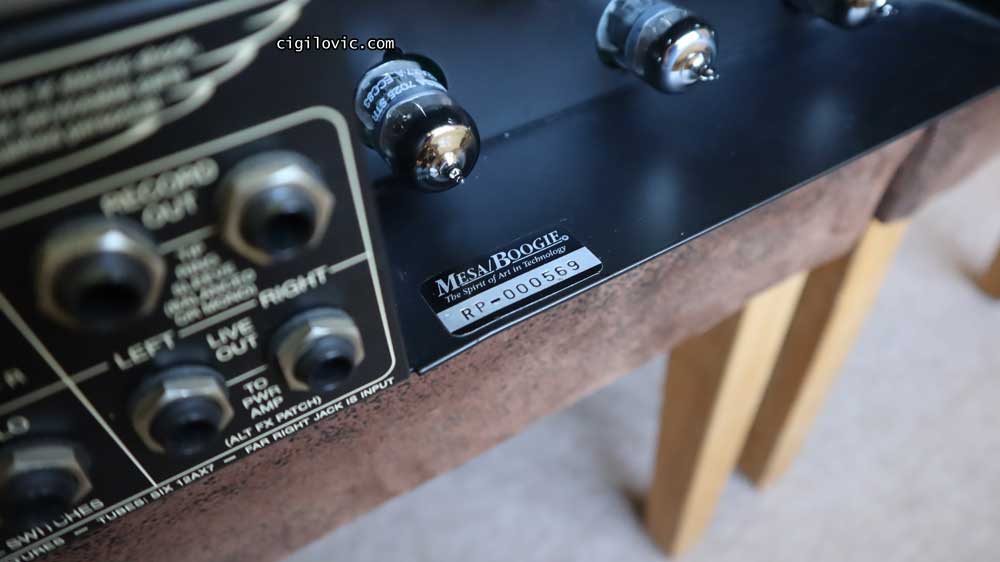
As I mentioned, I just got this in a trade to end my craving for yet another legendary tube guitar preamp! I believe this will never end with me, as I want to try everything and document my experiences with these tube guitar preamps. The one I got did not come with the tube casings, as you can see from the image below. Unfortunately, the seller did not mention this to me. However, I didn’t see any issues because of the lack of tube casings. There’s no additional noise introduced to the signal, just so you know!
Serial Number and Revision Topic!
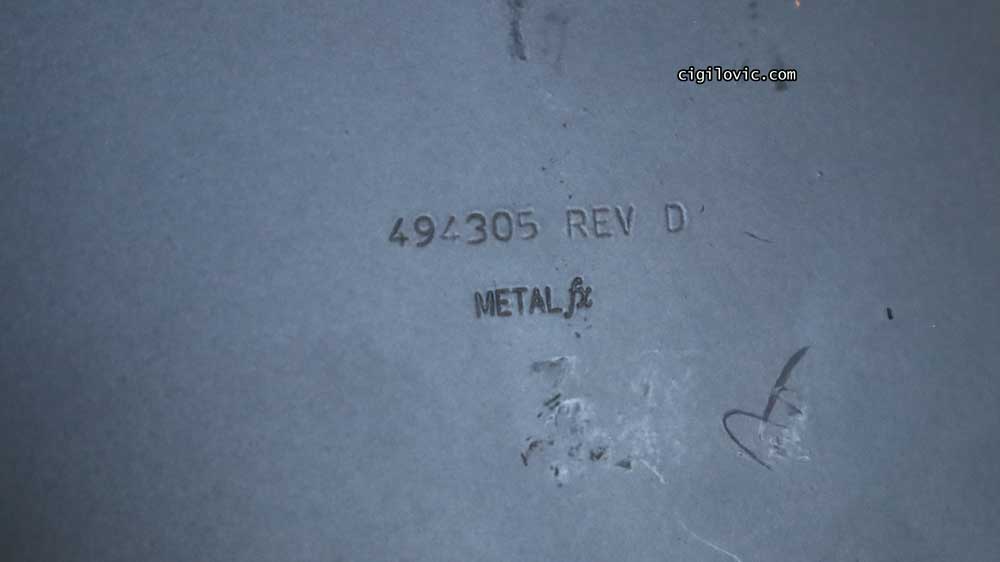
The serial number is RP-000569, and it sounds like an early unit. As I always want to confirm these details with the manufacturer, I contacted Mesa Boogie customer support, and they immediately got back to me. According to Mesa Boogie, this was shipped on 09/10/2002. When I was taking gut shots of the unit, I noticed the REV D stamp on the upper chassis. 
Mesa Boogie told me that they kept track of revision #’s, and that has become more internet fascination than anything they ever felt was of significance. Revisions were usually board layout changes and had nothing to do with the functionality or tone of the amp.
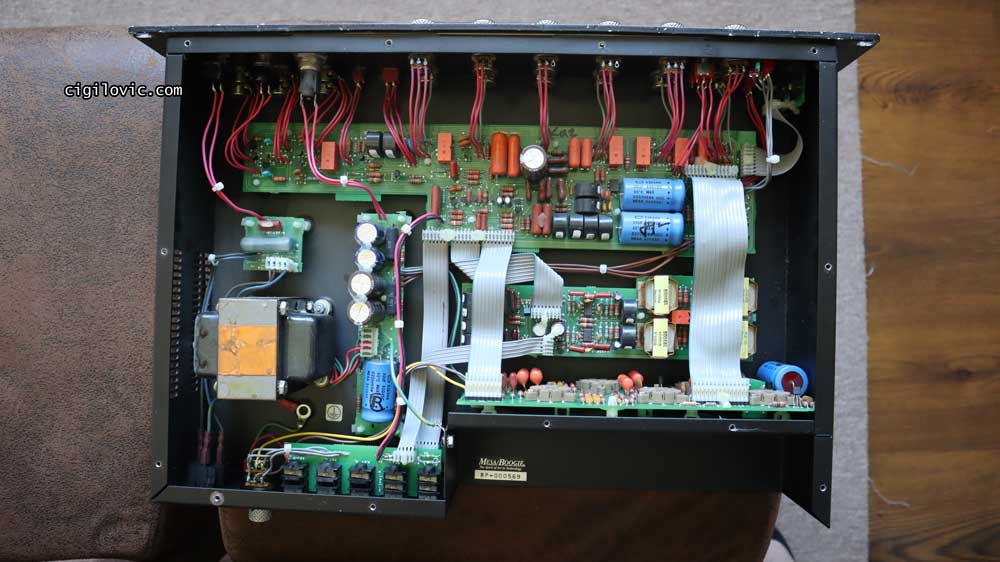
Although the preamp is already 22+ years old, the build quality has helped the unit to survive all these years without any issues. There’s no crackling pots, no noise, nothing! It’s built like a tank, and I believe it will serve the next player for years to come! Here are some gut shots of the Rectifier preamp. As you can see, it’s very well-made!
Fortunately, the seller also included the original footswitch with a TRS cable. The footswitch is a very simple one, allowing you to switch channels and also activate the boost.

The only weird design decision (maybe it’s a Boogie thing) is that the footswitch input is on the front panel. Also, you need to indicate whether you are using the footswitch or not by selecting this on the front panel. You can use the mini switch on the front panel to choose Channel 1 or Channel 2, or you can choose the Footswitch mode to activate the footswitch.

Here are some more gut shots for you! What a built quality! It clearly defies the decades of existence!
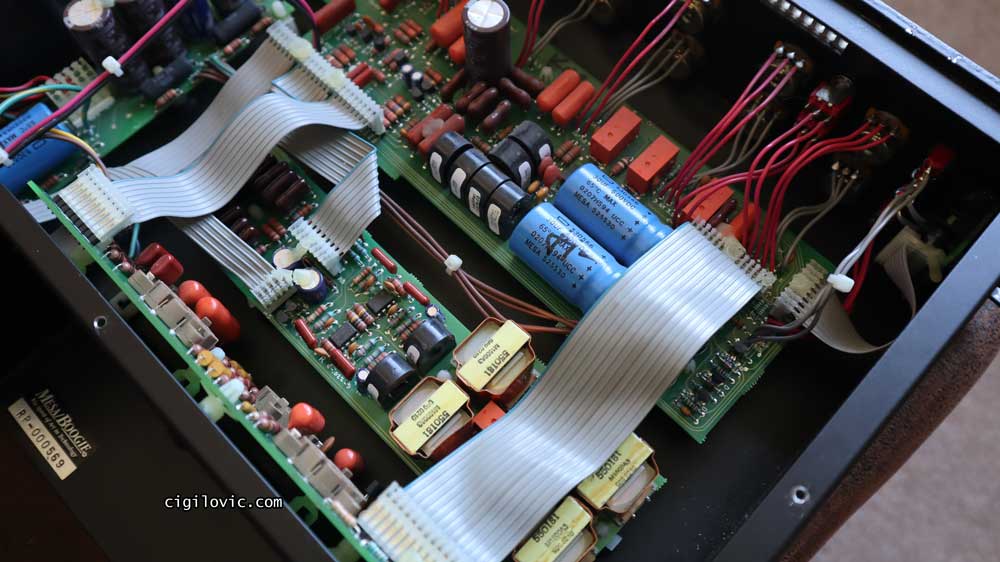
While I was inspecting the circuit board, I noticed something really cool! Mesa Boogie decided to answer people who would question the Rectifier Recording Preamp!
Yes, it’s official, it’s the Real Deal! 🙂

At first, I had mixed feelings about the Rectifier Recording Preamp as I thought it was too simple and not versatile. At the same time, I felt a bit overwhelmed by the sheer amount of mini-switches, voicings and everything. But right after I started using it and focusing on a single channel and the voicing, it made so much sense! I was wrong with both initial impressions. Another thing that surprised me is the clean channel. I wasn’t really expecting clean and pushed cleans from this channel. However, when I started using the EQ and also the Master volume for this channel, I was shocked by the amount of gain and grit it could produce. 
When combined with a boost pedal, you can have a huge amount of aggression even from the clean channel modes. Based on the guitar and the pickup you use, the clean channel will get cleaner or dirtier. The EQ section for both channels is so sensitive and adds a lot of character in terms of gain structure, texture and feel. As I mentioned a couple of times here, always review your EQ settings when changing modes and guitars.
If you watch the demo video I made, you will notice that I spent a lot of time on the clean channel, testing and feeling the texture of the gain and harmonic content. Channel 2 is also excellent, as most people buy this preamp for this circuit. In the video, I start with the Raw mode and Gain around noon. Notice how dark and gloomy the clean sounds are.
As soon as I started playing with the Gain settings, it also started responding and becoming an aggressive beast. The texture and the harmonic content become way more pronounced when boosted. I do not understand why some players don’t like the Rectifier Recording Preamp. It sounds like a beast to me, and I can feel the Recto aggression and rawness every minute I play this preamp. It definitely makes you play a certain way. I didn’t even notice how long I played in that video without a break, standing up with my guitar strapped on me! 🙂 I just wanted to play random power chords and push as hard as I could to feel the aggression of the preamp!
For my taste, I think the Vintage mode on Channel 2 is the best. I also loved the Raw mode with a boost pedal in front of it. The Modern mode was also a great-sounding voicing, but I would prefer the first two voicings. To be honest, it is so difficult to choose a favourite voicing on both channels, as all of them can sound excellent in heavier music genres. 
I can easily confess that the Mesa Boogie Rectifier Recording Preamp shocked me so badly that now I consider a Mesa Boogie Rectifier amp a must-have amp on my wish list! I can’t imagine how a real Dual Rectifier would sound and feel in a room! On top of that, I have to confess that I enjoyed playing Rectifier Preamp way more than the TriAxis, as it is just able to do a couple of things well instead of offering tons of options! Overall, I can recommend that anyone give the Boogie Rectifier Recording Preamp a chance. Don’t be discouraged by the people online claiming that this is a terrible rendition of the Recto DNA. It’s absolutely not!
Pricing & Availability
If you are ever looking for one on the internet, chances are you may find some on Reverb.com and eBay as well.
Check out Reverb.com for Mesa Boogie Rectifier Recording Preamp for sale!
As I mentioned in the article, there is some guitar gear that you must try before you leave this world, and the Mesa Boogie Rectifier Preamp is one of them, trust me! 🙂 I hope you find this article honest and insightful! Thanks for visiting my blog and supporting me so far! I will hopefully see you in the next review here!
Post your comments and feedback here
By submitting a comment, you accept that you will be automatically included in the newsletter. You can always opt out in case you are not interested in the content updates.


