- Excellent combination of specs for a modern Strat
- Sweet spot with all the components, parts and decisions by Fender
- Superb playing experience, a true, authentic Strat sounds
- Legendary Custom Shop pickups
- As mentioned in the article, there may be blind spots you need to be aware of
- Unfortunately, replaced by Am Pro II series (I'd prefer US Standard Strats made in between 2013 - 2015)
Hello everyone, I hope you are all doing great! Back again with another honest electric guitar review for you. This time, we will be looking at a Fender American Standard Stratocaster (Maple Neck) in mesmerising Mystic Blue! 🙂 To be honest, this particular guitar has been on my radar since I first came across it in 2014.
Table of Contents
As I have mentioned in my other articles and reviews, I used to be one of the luckiest guitar nerds around since I had the chance to test, play and record dozens of guitars in the Turkish MI market. In my opinion, Fender did an excellent job between 2014 and 2015 in providing one of the greatest Strats, with an excellent combination of specs, sweet finishes, and colours.
Fender American Standard Stratocaster
Unfortunately, I wasn’t really able to afford a US-made Strat back in the day and always went for more budget-friendly options, such as the SX SST62 Stratocaster and the Vintage V6 Reissue Stratocaster for my own collection of guitars. Recently, in early 2020, I decided to go for the one and really put some effort into finding the one I always wanted! But there was a problem; Finding a second-hand Fender American Standard Stratocaster from that era was not an issue; however, finding a Mystic Blue, which is my all-time favourite Fender finish, was almost impossible.
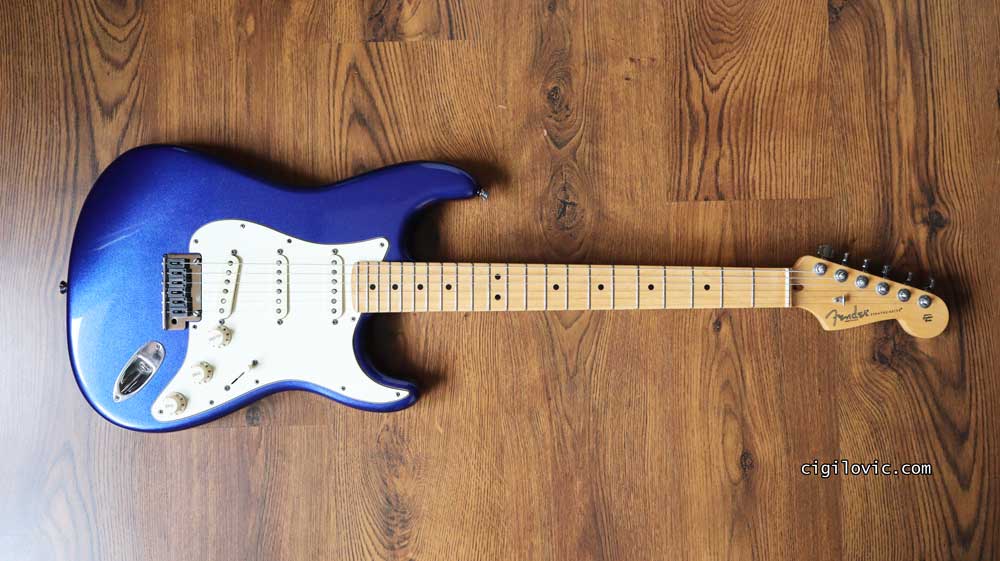
In my first week of searching for this guitar, I was able to find one, but by the time I contacted the seller, it was gone already 🙂 So I kept searching for it at random times every day and finally found one in the UK! The guitar was in good condition, but there were risks to take, as even though it’s a Fender American “Standard“, it may have had manufacturing errors.
Please consider supporting this blog by buying your gear from Thomann using my links at no extra cost to you, many thanks!

You may say, “How can you be so certain about it? It’s a US-made Strat!” Well, having tested almost all Fender and Squier ranges in that era, I can easily say that there was no standard, even in US-made ones. To be honest, US-made Fender guitars with rosewood fingerboards always came with higher consistency in terms of craftsmanship, but the ones with maple necks were always different. This would be much more obvious in the finish of the fingerboard, as you will find out in this review. Since I was aiming for a maple neck version, my risks were doubled. But I went for it anyway 🙂 Before we dive into many more details and talk about an almost enforced modification/upgrade that I did, let’s have a look at the tech specs first.
Tech Specs
| Fender USA Standard Stratocaster (2014) | Tech Specs |
|---|---|
| Body | Alder |
| Body Finish | Urethane |
| Design | Stratocaster |
| Neck | Maple |
| Neck Finish | Satin Finish on Back, Gloss Finish on Front |
| Neck Shape | Modern "C" |
| Scale Length | 25.5" (648 mm) |
| Fingerboard | Maple |
| Radius | 9.5" (241 mm) |
| Number of Frets | 22 |
| Fret Size | Medium Jumbo |
| Nut Material | Synthetic Bone |
| Nut Width | 1.685" (42.8 mm) |
| Position Inlays | Black Dots |
| Truss Rod | Bi-Flex |
| Pickups | Custom Shop Fat '50s Single-Coil Strat (Bridge, Middle, Neck) |
| Controls | Master Volume, Tone 1. (Neck Pickup), Tone 2. (Bridge/Middle Pickup) |
| Configuration | SSS |
| Bridge | 2-Point Synchronized Tremolo with Bent Steel Saddles |
| Hardware Finish | Chrome |
| Tuning Machines | Fender Standard Cast/Sealed Staggered |
| Pickguard | 3-Ply Parchment |
| Control Knobs, Switch Tip | Aged White Plastic |
| Neck Plate | 4-Bolt with Micro-Tilt Adjustment |
| Strings | Fender Super 250L, NPS, (.009-.042 Gauges) |
| Other Features | Bent Steel Saddles with Elongated String Slots, Copper Infused High Mass 100% Metal Bridge Block, Thinner Undercoat Finish for Improved Body Resonance, Tinted Neck, Aged Plastic Parts. |
| Included Accessories | Hardshell Case, Cable, Strap, Polishing Cloth |
As you can see from the tech specs, it’s pretty much a standard, 3 single-coil Strat design and guarantees to give you the infamous Strat tones out of the box. We are going to have a more detailed look at each part in the review section here.
Review
Headstock
Let’s start with the headstock. Fender American Standard Strats feature the classic Strat headstock. I think it’s one of the best headstock shapes ever made! On the front, you have your Fender logo with the original custom body text, tuners and a single string tree for high E and B string.
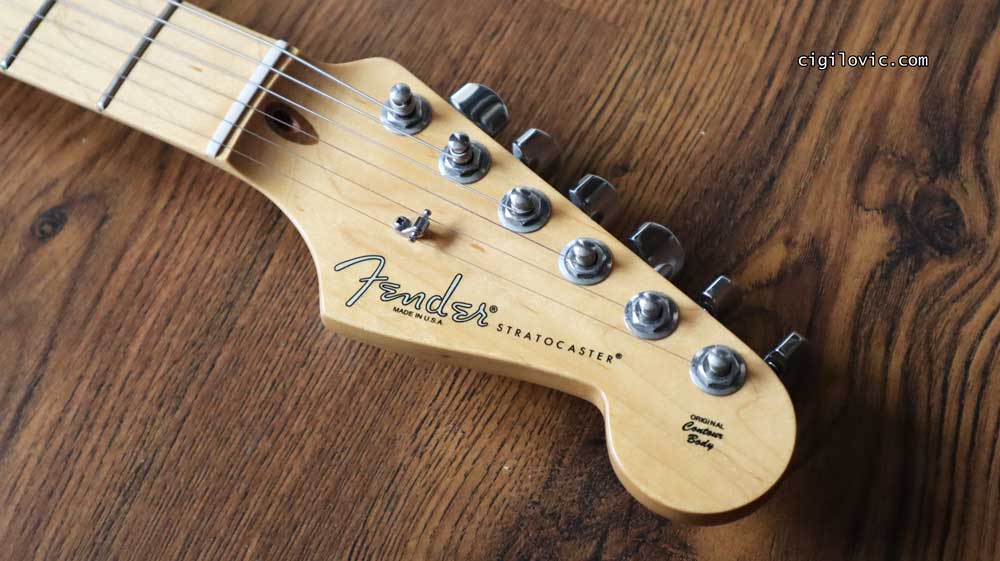
On the back of the headstock, you have your serial number. Mine has US13094252, although I thought this was a 2013 version based on the “13“, it turned out to be a March, 2014 version. Probably, I don’t know how to read these by instinct :).
You can look up your Fender serial numbers here on the official Fender page.
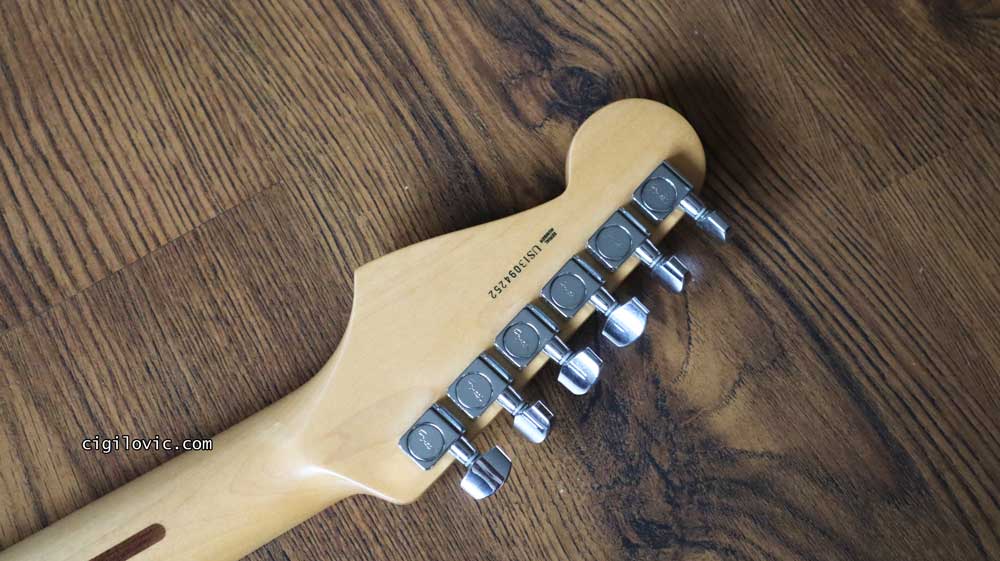
The tuners here are Fender Standard Cast/Sealed Staggered, and I believe these are the same or very similar to the current tuners used in the Fender American Pro II series guitars. In my opinion, these are perfect tuners, never had any issues with tuning stability that might be caused by the tuners. 
Neck
American Standards come in two options as far as the necks are concerned. You have maple necks with either rosewood or maple fingerboards. I went for the maple fingerboard version. The neck is a “Modern C” profile neck, which is extremely comfortable. Although Fender uses this term widely for many guitars, the actual feel of these neck profiles might be very different from guitar to guitar.
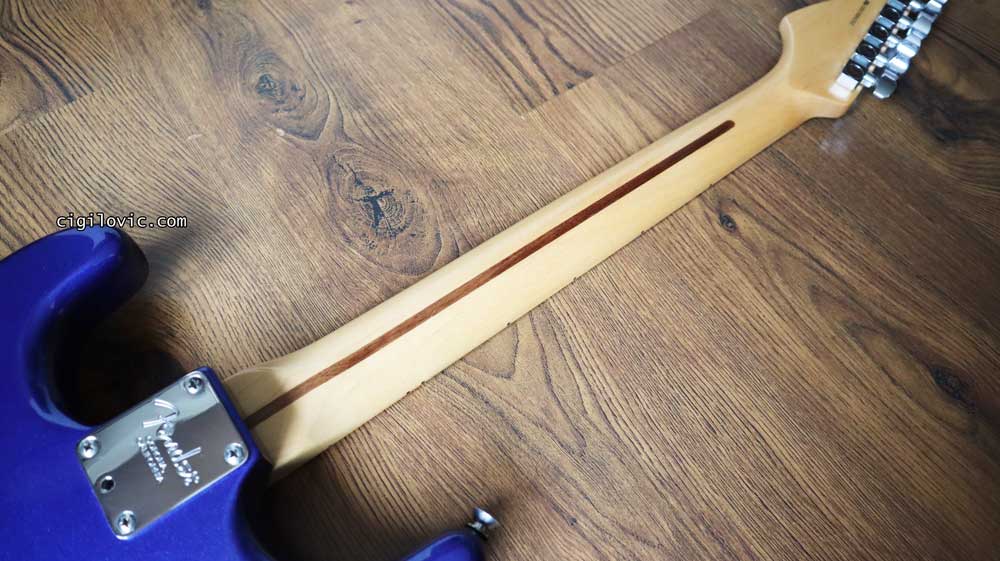
For a recent example, you may take my Fender MIJ Hybrid II Stratocaster. It also features a C profile, but it’s way smaller and slimmer. My American Strat has a much thicker and more bulky C-profile neck. I believe the neck contributes to the acoustic tone of electric guitars a lot. My USA Strat has been the loudest electric guitar I have ever played; it sounds so resonant and alive.
Fingerboard
Here we have the lovely maple fingerboard. Note that these USA Standards, which were made from 2013 to 2015 (at least what I used to test weekly), would always come with a thick finish (maple fingerboards only). It’s actually pretty good in my opinion. I used to like the plain, unfinished maple boards. But I think maple boards with a thick finish feel great and are very smooth.
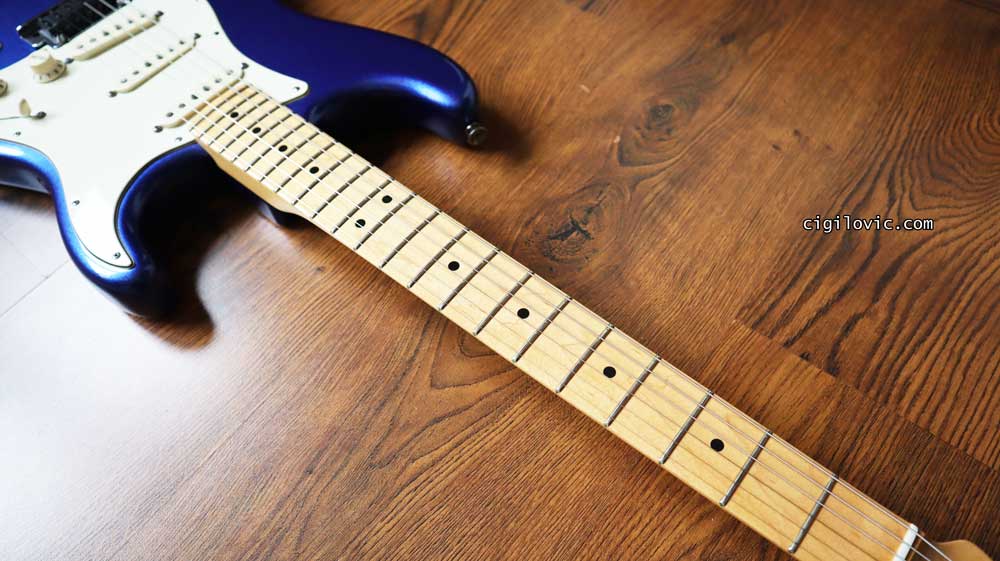
The neck has a scale length of 25.5″ and features a 9.5″ radius with 22 medium jumbo frets. In my opinion, these specs are the sweet spot for any S-type guitar. Very easy to play, easy to bend, and no choking down on any notes while bending! The nut here is a synthetic bone according to the tech specs. To be honest, I never had tuning issues with this nut. I believe it was cut pretty well. But as with many guitars, I stopped having tuning issues after this guitar really settled in my environment and with my playing (even tuning style). 
Neck Plate & Neck Joint
Here’s a close-up shot from the neck plate. It features a classic, 4-bolt neck joint with the Fender, Corona, California stamp on the metal. As you can see, there’s also a hole to adjust the tilt of the neck. To be honest, I never needed to adjust it, but it’s there in case you need to.
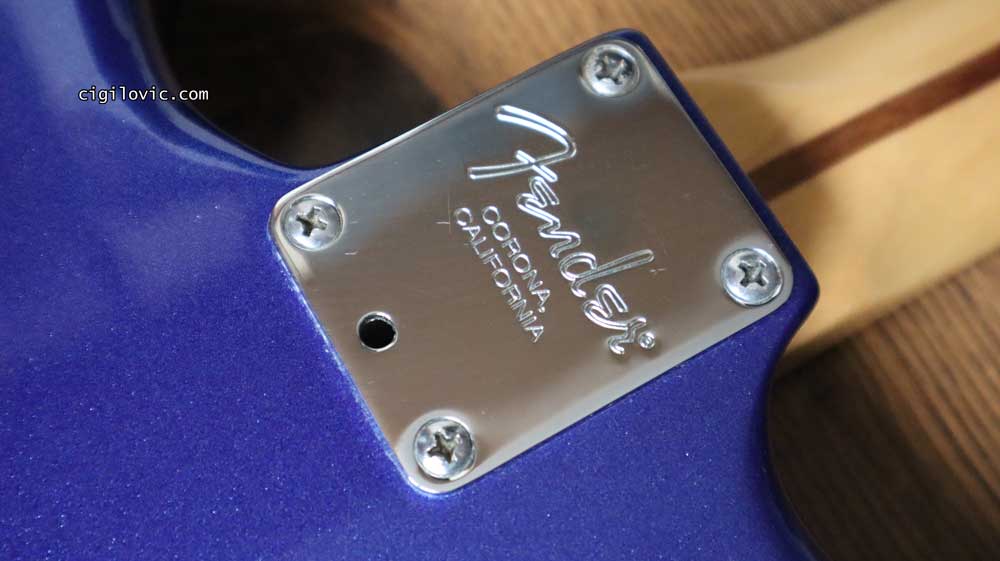
Unlike the modern equivalent, American Pro II guitars, the USA Standard doesn’t feature anything modern on the neck plate. It’s pretty pokey and not the most comfortable one for accessing higher registers. However, I don’t think I have ever complained about this. After a while, when I started owning multiple guitars such as FGN Boundary Odyssey with a smooth, more comfortable 4 bolt neck joint with a similar neck plate, I realised it was a lot more comfortable to play with that smooth, rounded neck plate. I think this should be standard for any bolt-on instrument as the bare minimum comfort-related spec. But Fender and other companies have to continue offering both flavours for the “purists”. 🙂
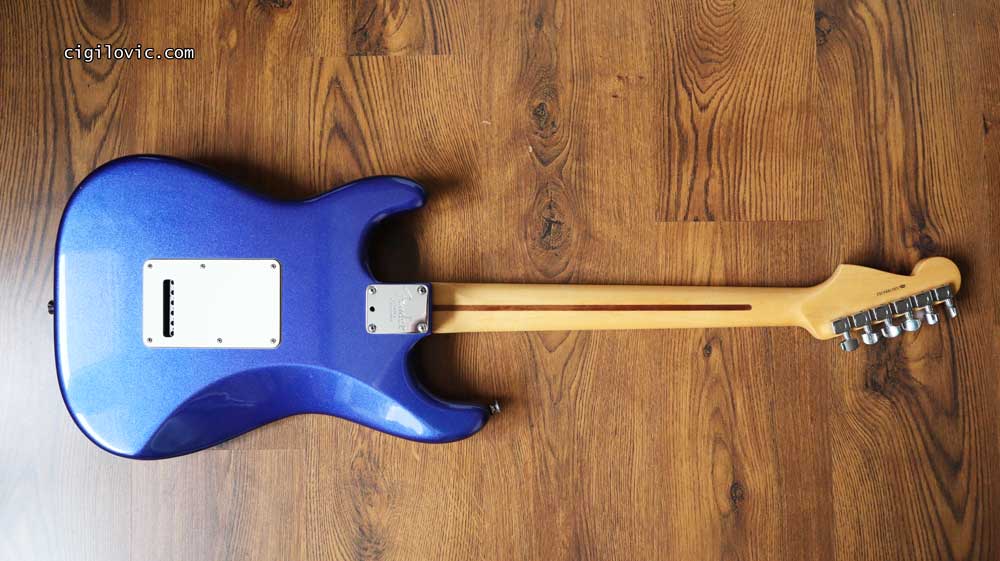
In my opinion, the American Standard series, as well as the American Pro II Strats, are the sweet spot for the Fender brand. Everything works so smoothly! All the specs are in the sweetspot; nothing is edgy. Modern enough to convince any modern player while vintage enough to satisfy purists. Here’s another shot on the back of the guitar. Ahead of its time, ergonomics! 🙂
While talking about all the positive sides of this lovely instrument, I also want to share some of the findings from my initial test. Note that I bought this guitar second-hand (maybe third-hand, not sure), and some of the things I will be talking about here might be caused by normal usage. However, there are some things that I detected about how this guitar was shipped out of the factory. 
Finish Spillover on Frets
As I have mentioned above, I was really concerned with the maple fingerboard as I had tested many brand new Strats from this era with different gloss finish thicknesses. There were even ones that came with a huge thickness, along with the gloss finish being sticky! The one I have fortunately did not come with a sticky gloss finish on the maple board, but with a quick check, I noticed some anomalies in the high register. In the image below, you can easily see they used an excessive amount of lacquer in the high register end. It doesn’t really affect anything playing-wise, but it still shows that not all US-made Fender Strats come with “Standard” build quality.
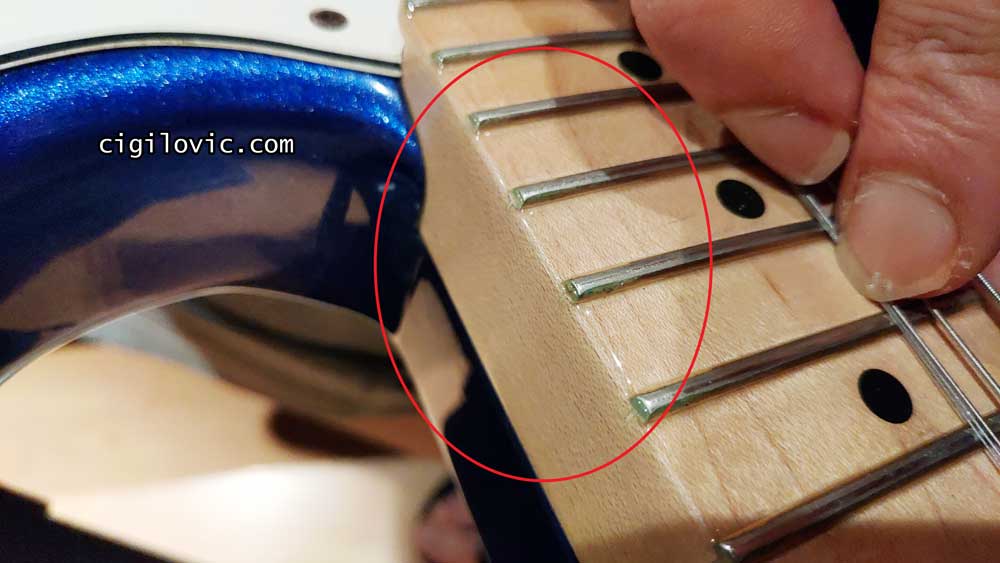
I believe this is almost inevitable with the finished maple necks, at least this was what I heard from the people. It absolutely doesn’t impact the playing feel, but it looks pretty dirty, especially on the higher registers. As you can see from the photos, I think this is how these guitars are manufactured. Shape the neck, add frets, apply finish, then deal with levelling and crowning.
Problem with Finish
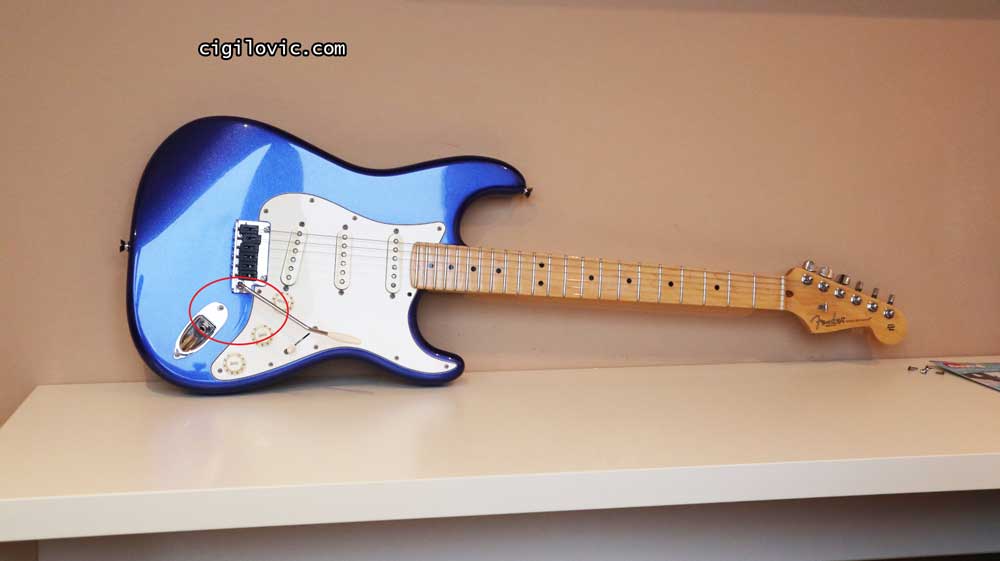
The second issue is also about cosmetics and has nothing to do with playing; however, I was very surprised when I noticed a flaw in the guitar finish. You can easily see this from the image below: the cooling and settling of this marvellous finish was probably done without giving much attention. Next to the output jack plate, the finish had a thickness difference which was really easy to spot with a bare pair of eyes from the right angle.
Worn-Out Saddles
The third issue was about saddles. To be honest, even though I have a significant amount of experience in testing electric guitars, I didn’t even check them (silly me!); instead, I set them up and played them rarely. The previous owner had strung the guitar with a set of Elixir Nanoweb Super-Light, which is my all-time favourite guitar string brand, and from my 10+ years of experience with Elixirs, I was confident that it had been 2-3 months old (checking the flakes that started to emerge on the D string). So I thought I could use them for the upcoming months without a problem.
Only fools keep their cash in a bank account! Let your money work for you with the most trustworthy broker ever!

But a really strange thing happened to me! I was practising some songs (see the example song below), and bent the 22nd fret on the high E string! Ended up with a broken string! :/ I was sad and ordered a new set of strings from Thomann, and a week later, restrung my Strat again. Guess what happened? I played the same note again, and on the very first try, boom, another broken high E string!
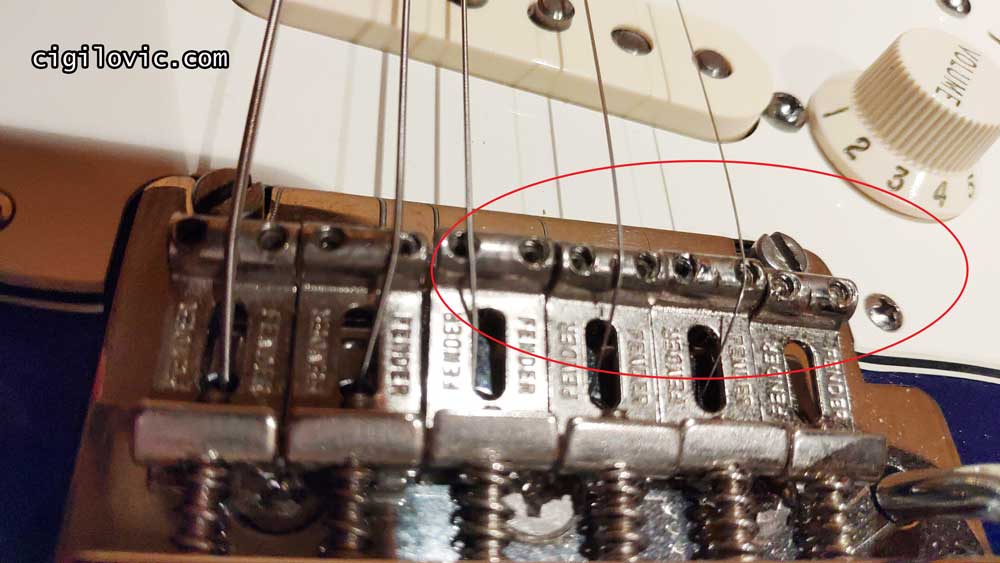
I was first concerned about my playing as I hadn’t been playing the guitar often anymore in recent years, which may have led me to have uncontrolled power. However, given the fact that I had only broken high E strings twice in the last 20 years, I wanted to look into this issue. As you can see in the image, the saddle was eaten up by the string, which turned it into an almost knife, cutting the string from the saddle end in the first attempt!
Iron Maiden – Wasted Years cover

You may say, this can happen to any guitar; however, the guitar was almost in brand new condition since the frets had no marks of playing and also the previous owner just used it for some strumming chords at weddings/church events…So I was really disappointed with saddle quality and went for another order from Thomann, this time including a set of Graphtech saddles!
Which Graph Tech Saddles Should I Buy for my Fender Stratocaster?
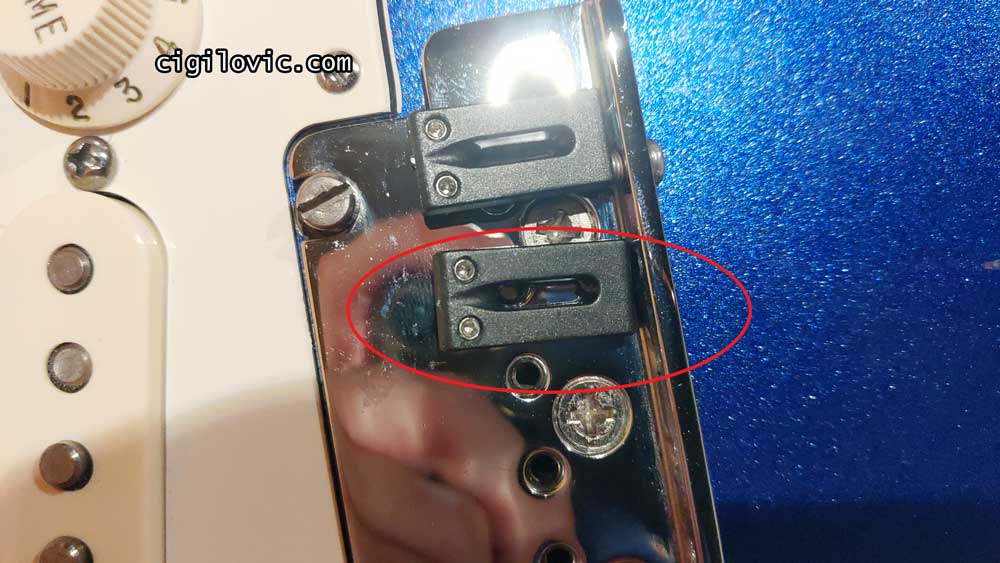
With a sense of urgency to fix my guitar and start playing again, I ordered Graph Tech PS-8001-00 just by reading the short description, but I was wrong! Even though it’s promoted as a replacement for American Strats, it was offset, which means the intonation screws were offset rather than in the centre. See the image below. It’s actually not Thomann’s mistake, as you are responsible for measuring your string spacing and checking your bridge construction to choose the right one.
How to Upgrade Stratocaster Saddles with Graphtech?
The correct one is Graph Tech PS-8000-00 StringsaverMexStrat, as the product name suggests, you should go for this one if you have an imported Strat (a.k.a Mexico or China ones). However, it has nothing to do with the quality of saddles. Both versions guarantee identical quality. Instead of going for the product description and name, I highly suggest you check out the Graphtech product catalogue.
On page 46, you can easily notice that there are only 2 different E-to-E measurements. Your Strat/Tele should have an E-to-E measurement of around 52.73mm unless you have a real vintage instrument. Then the next thing you should be careful of is to pick up the one with the correct intonation screw holes and not make the mistake I made 🙂
Europe – The Final Countdown cover

Installation is super simple; all you need to do is unscrew the intonation screws and mount them on your bridge. But don’t forget to adjust your intonation, as it will be far from being in tune when you tighten those screws. Since I had become really paranoid about string breakage, I also used Big Bends Nut Sauce, which I believe has been really helpful for minimising the amount of friction at the contact points. Lastly, I used Dunlop Micro Fine Guitar Polish 5410 to remove the thin layer of oxidised frets and also tried to thin out those excessive amounts of lacquer on the high register.
Body
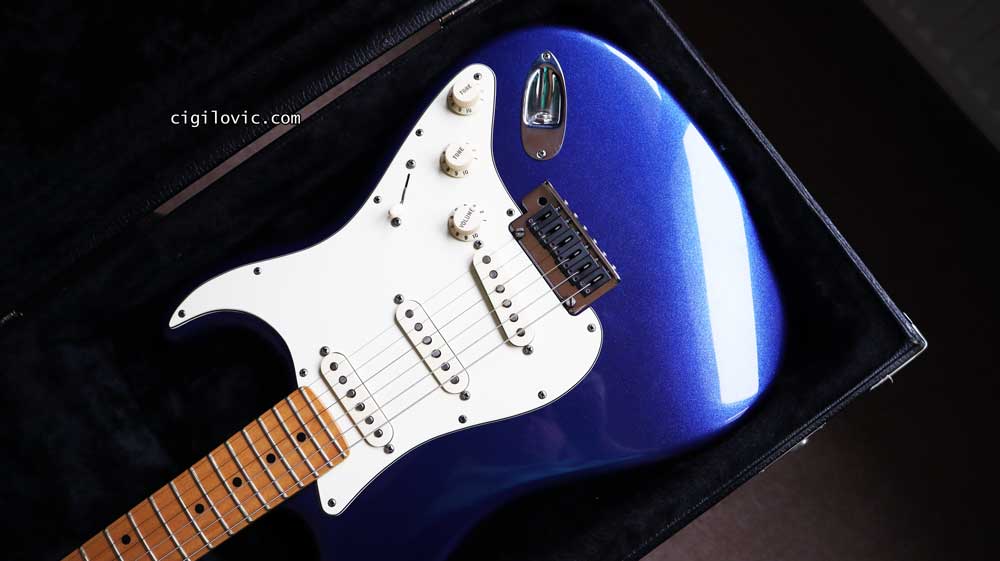
As with almost any Strats, American Standards also come with an alder body. I must say it is one of the lightest bodies I have experienced. It was just over 3kg (as far as I remember), so easy to control and play. Sounds and feels great, extremely resonant body, not to mention one of the most beautiful finishes ever, mystic blue!
Pickguard & Plastics
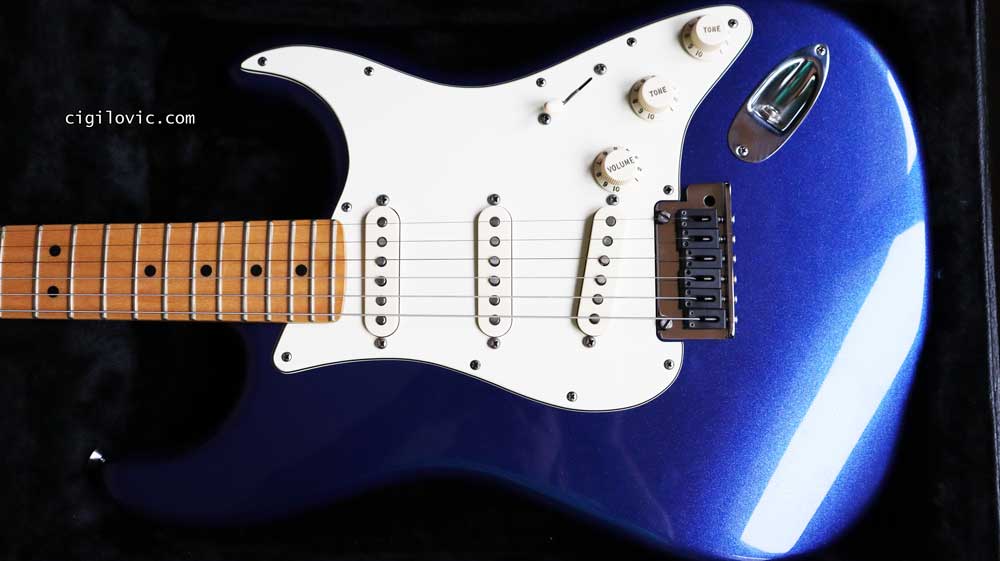
As you can see from the photos, this guitar comes with a standard Stratocaster pickguard that hosts 3-single coils with a master volume and two tone pots, along with a 5-way switch. The pickguard here is a 3-ply parchment pickguard in white colour. As mentioned in the tech specs, plastics are aged white, while there was nothing mentioned for the pickguard’s colour. At first glance, all of these plastics look white to me. But different photo angles and lighting will yield different results. See the photo below for the aged plastics effect.

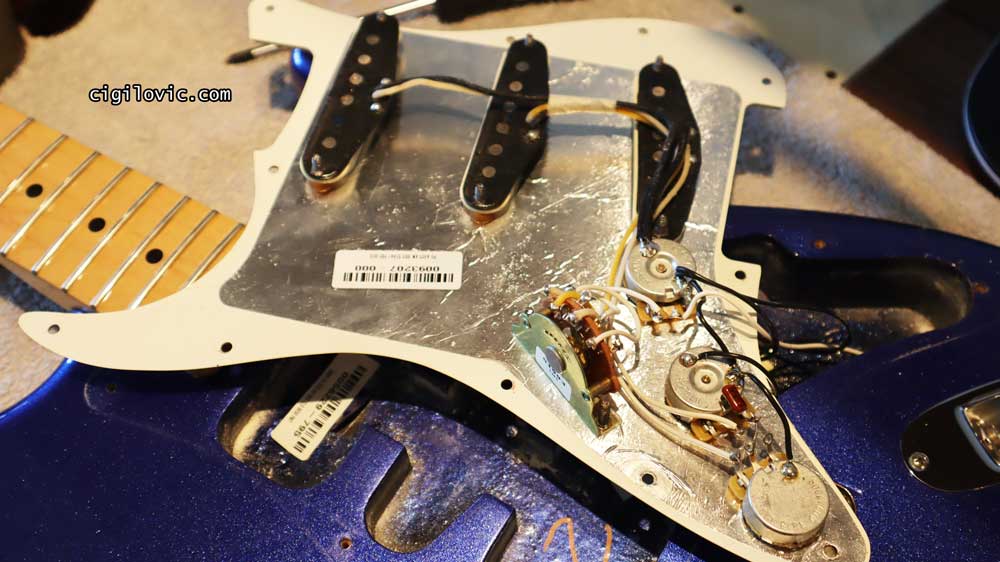
To document everything here, I also took some photos of the pickguard during an intense maintenance session! 🙂 You can actually buy this pickguard loaded with Custom Shop Fat 50s here.
Pickups
And the pickups! Probably the best part of this guitar. USA Standard Strats would come with one of the sweetest single-coil pickups by Fender, Custom Shop Fat 50s! Words are not enough to describe these pickups. I think these are my favourite single coils ever.
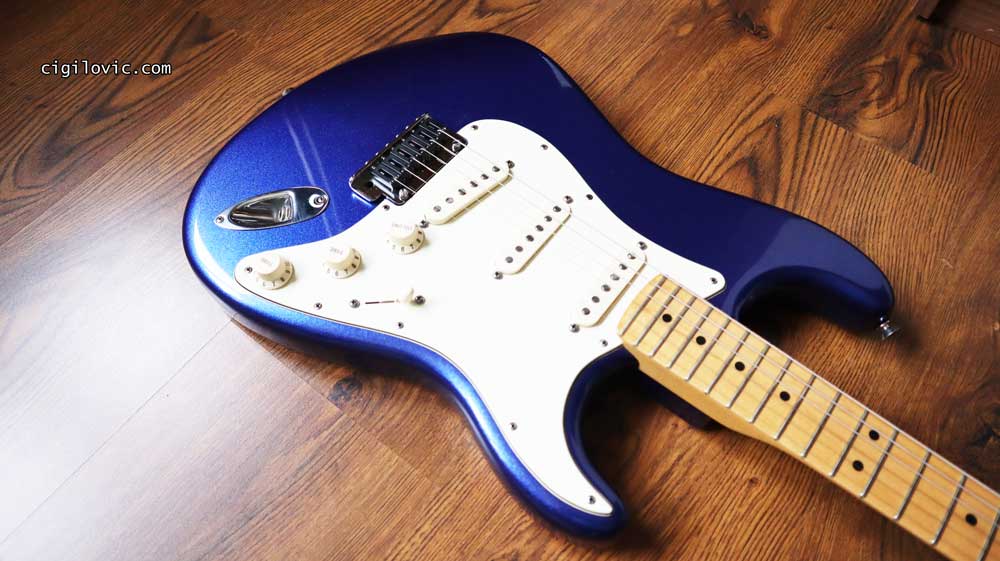
CS Fat 50s sound big, bold, wide and huge in my opinion, while giving you all the pleasure and pain about single coil pickups! I have a separate review article where you can get a lot more information on these pickups. Also, check out another guitar cover featuring my Strat below.
Check out my Fender Custom Shop Fat 50s pickup review here
Rainbow – Long Live Rock n Roll cover

Electronics
And the electronics are one of the most surprising aspects of this guitar. Note that when I got my guitar (used), it was already 5+ years old. It was manufactured in the USA, somehow came to the EU and was bought by someone in the UK. Then, years later, someone bought this again in Slovakia. So basically, this guitar has travelled a lot, right?
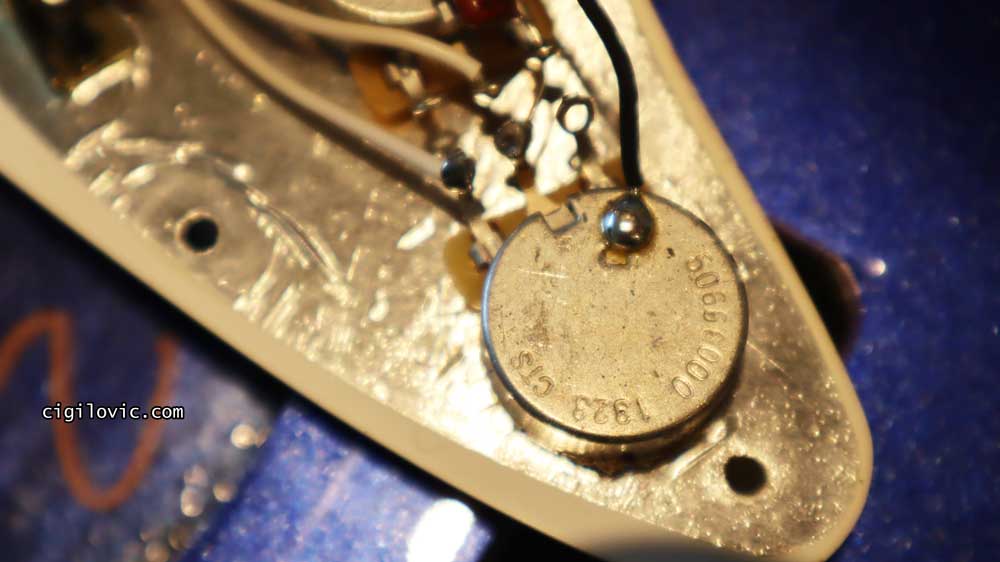
The electronics on this guitar are possibly the most durable and solid components I have ever experienced. No sign of oxidation, dysfunction, or anything. Unbelievable quality! As you can see from the image, it has CTS pots.
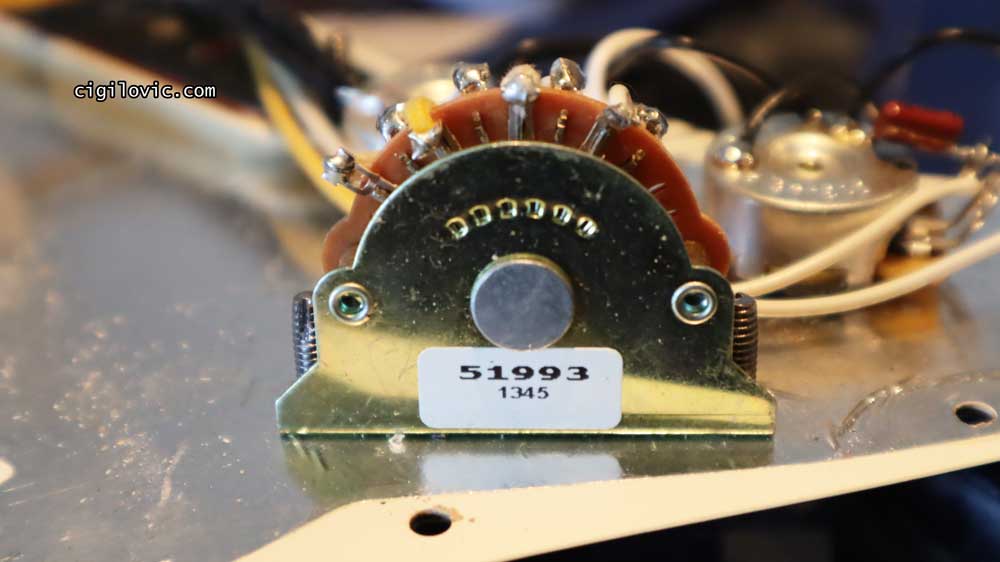
And here, a close-up shot of the super nice switch under the pickguard. I believe this is a Fender switch. The part number seems to be 51993 1345.
Hardcase
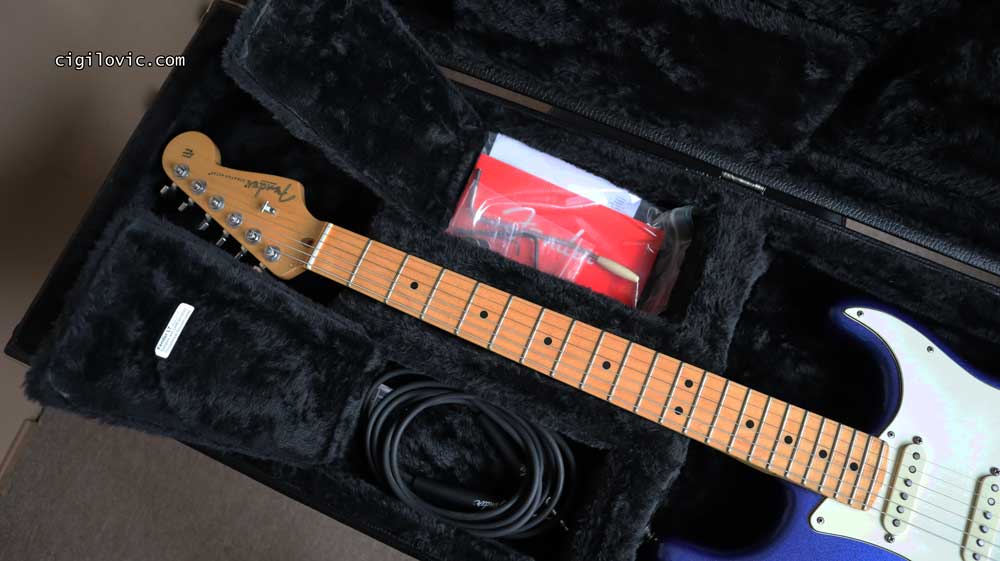
Last but not least, as with any US-made Fender guitars, it’d come with a proper, heavy-duty hard case. Personally, I don’t like hardcases, and I’m fine with padded gig bags. However, it never hurts to have this, as when you ship these guitars, it’s going to give you peace of mind.

I was also lucky to receive most of the contents of the box, even though this guitar was a used one. It comes with a Fender cable, Strap, allen keys, manual and instruction brochures. The hardshell case is pretty solid and features nice spaces inside to store everything.
Sound Demo (no talking)
Along with this brutally honest review, I also wanted to record a demo video (MyDukkan style) in which I just played a couple of riffs, lines and some improvised solos and riffs. If you are interested, I highly suggest you watch this video. In this video, I’m using my ENGL E570 all-tube preamp, ENGL Cabloader, directly into the RME Babyface PRO audio interface. Also added a touch of Lexicon reverb (VST). For the video, I had to restring my Fender Strat with Elixir Optiweb 19002 set.

Conclusion
What to say about a classic Fender Stratocaster? I strongly advocate that many Fender models, regardless of their series or models (down to Squier Affinity, Mexico Strats, and American ones), promise a huge value and are mostly very consistent with quality. In my opinion, Fender American Standards are just the sweet spot for Strat lovers with high-quality components. As you have seen in the article, there may always be nasty surprises waiting for you, but if you feel confident with the build quality and timbre of the guitar, chances are you will love your Strat. I think Custom Shop 50s pickups sound excellent, they are my favourite single-coil pickups! It sounds very full and rich in various settings. Recently, I published an article covering Fender Custom Shop Fat 50s Stratocaster pickups. So don’t forget to check that out as well!
Check out my Fender Custom Shop Fat 50s Stratocaster pickups review here.
If you want to own a Strat but don’t really want to spend your time and money upgrading every component, I definitely suggest you go for an American-made Stratocaster! 
Pricing & Availability
Unfortunately, you can not buy these particular Fender American Stratocasters brand new anymore, as they have been replaced with Fender American Professional II series guitars. Although these are very similar to the legendary American Standards, I think I might miss the Custom Shop Fat 50s pickups. But you never know, I have never tested them for long-term anyway in my setup. Thomann lists many of the options under this series, with possibly the best pricing ever!
Check out Fender American Professional II Stratocasters on Thomann here
The good news is that the American Standard Strats are widely available all year round via Reverb.com. Many sellers are listing pristine condition US Standards. Just beware that you should aim for the ones manufactured between 2013 and 2015. Before these dates, my experience would be invalid, because I never played one. The only one I played was a late 90s US Standard Strat, which I disliked so much!
Check out Fender American Professional II Stratocasters on Reverb here
Last but not least, for the latest available items from official Fender on Amazon, please check out the link below.
Check out Fender American Professional II Stratocasters on Amazon here
I hope you have found this article, original images and videos useful and inspiring. Thanks for visiting my blog and supporting me so far! I will hopefully see you in the next review here!