- All around, excellent quality cables
- Tangle and noise free, durable build
- Comes in different colours, lenghts and plug options,
- Gold-plated connectors
- Maybe a little bir expensive for a made in China cable
Hello there, in this brief article, I would like to review one of my recent purchases from Thomann. Based on user reviews, Ernie Ball instrument cables are one of the best choices around. These cables have managed to score 4.9/5 in this competitive market! Ernie Ball instrument cables feature a high-quality design with excellent components that promise a high value/money ratio. These cables guarantee a long servicing time with excellent sound characteristics across the guitars’ frequency ranges.
Table of Contents
About Ernie Ball
Here’s a quick introduction and a quick history for those who have never heard of this wonderful company. Ernie Ball is a well-known and respected American manufacturer of guitars, basses, guitar strings, and other musical accessories. The company was established in the late 50s and has played a significant role in shaping the modern music industry, particularly in electric guitar and bass. The Ernie Ball story begins in the late 1950s when Clarence Leonidas “Ernie” Ball, a talented musician and entrepreneur, founded the company in Tarzana, California, USA. In the beginning, Ernie Ball focused on manufacturing custom-made steel guitar sets for country musicians and handling the demand that was started by the rise of the electrified instruments in rock’n roll music.
Please consider supporting this blog by buying your gear from Thomann using my links at no extra cost to you, many thanks!

The company revolutionised the guitar industry by introducing Slinky guitar strings in the early 60s. These strings were made of high-quality materials and way ahead of their time, and these attributes resulted in the company and the Slinky gaining a lot of popularity among guitar players who were seeking superior tones, durability, performance and playability.
The Slinky guitar strings became synonymous with Ernie Ball and remain one of the most iconic guitar string brands to this day! Throughout the 70s and 80s, Ernie Ball committed to innovation and quality to achieve its ambitions. The company’s guitar string line became the choice of many legendary guitar players such as Jimmy Page, Eric Clapton, and Jimi Hendrix, among others. 
On top of this, Ernie Ball Instruments gained recognition for its exceptional craftsmanship and sound, further solidifying the company’s reputation within musician communities. In the ’90s, the company started focusing on the expansion of its product lines and introducing bass guitar strings, accessories and other musical instrument-related products. Ernie Ball also acquired Music Man, which became a legend and a pioneer in guitar history.
Ernie Ball Instrument Cable
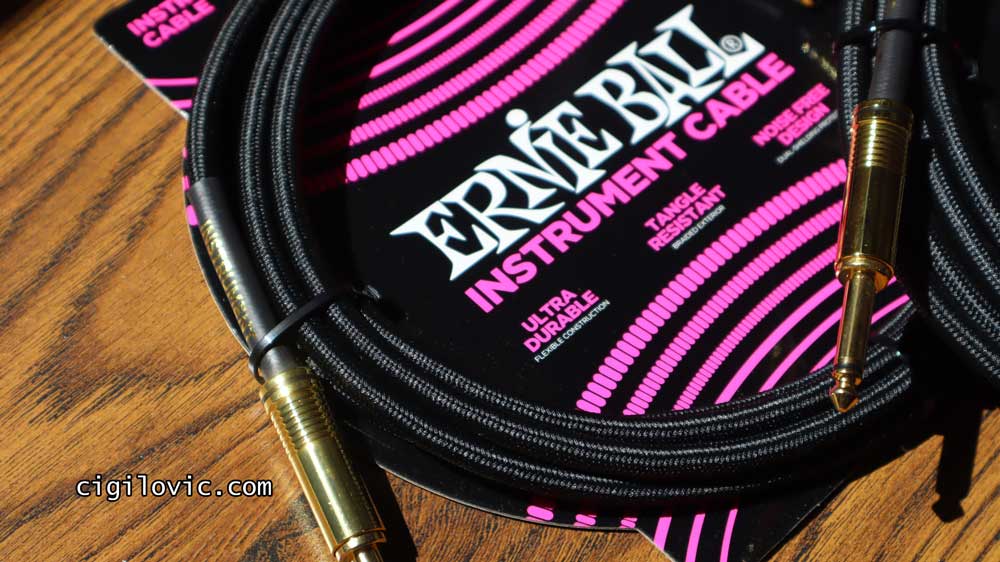
Ernie Ball instrument cables feature a high-quality design made with superior components that are built to last. Dual-conductors deliver reliably clear tone with crisp highs, tight mids, and rich harmonics. Multiple shielding materials preserve the signal with low handling noise, and the durable PVC jacket exterior ensures long-lasting performance.
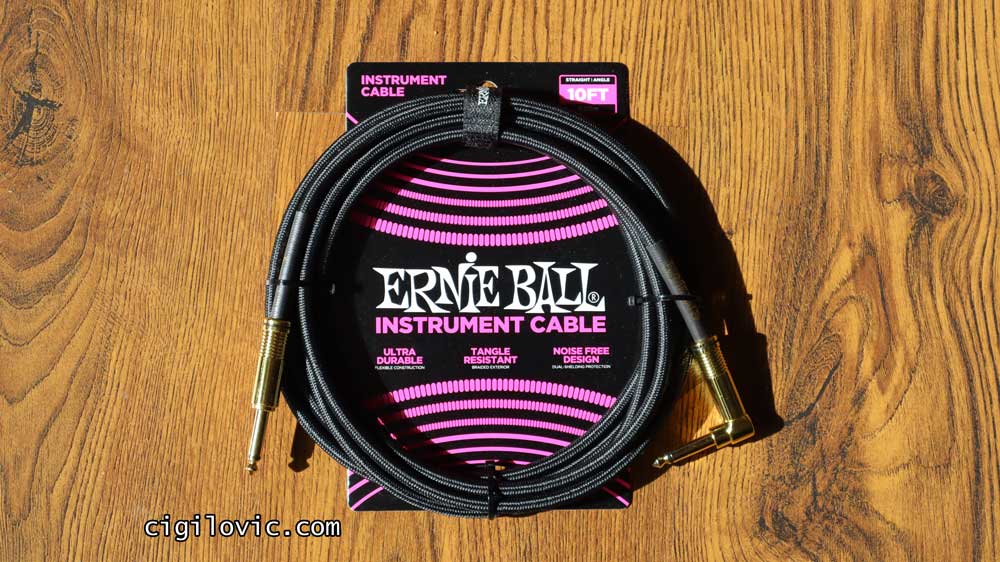
These cables come in different options. You may have two straight plugs or one right angle, while you may also have options for different cable lengths and colours. 
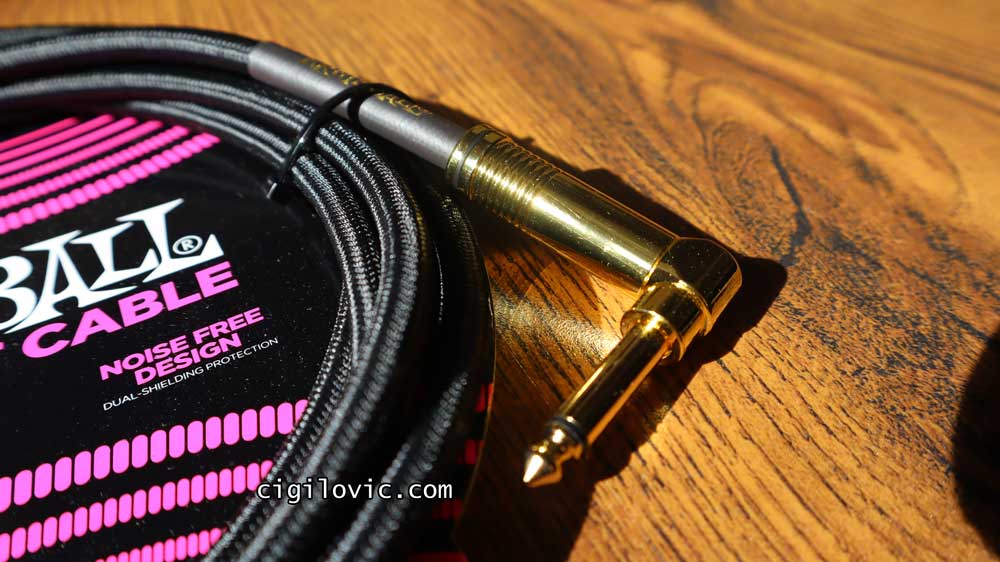
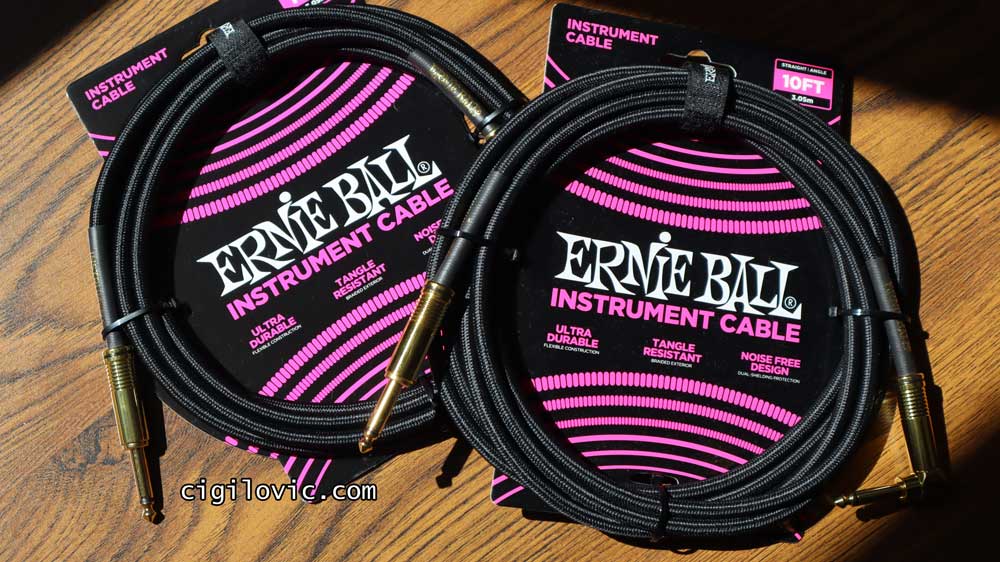
It comes with a simple yet very durable cardboard with branding and product details. My favourite one is the one in the images: Ernie Ball Instrument Cable Black EB6081, which features a black, 3m long cable with a right-angle and a straight plug. I think this is possibly the most versatile one, as a right-angle plug saves a lot of space on your pedalboard when needed.
Where is Ernie Ball Instrument Cable made?
Currently, I have two of these cables, and I have been using them for the last 5 years in my setups, usually at the FX Loop of my amps and preamps. For those who are wondering, I kept looking at the packaging, but couldn’t see any information regarding where these cables are made. 
When you search for this information on search engines, you may have some AI snippets that claim these are made in the USA. But unfortunately, there’s no solid information on the internet, including the official website.
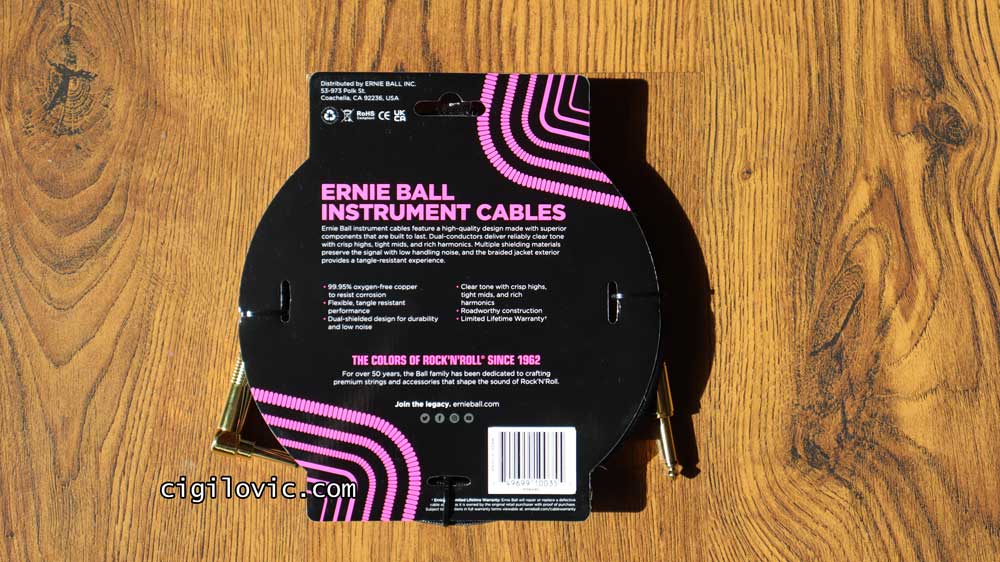
After a careful inspection of the package, I found out that they placed this information in the barcode section. See the barcode section on the left side, vertically. It says made in China.
Only fools keep their cash in a bank account! Let your money work for you with the most trustworthy broker ever!

Tech Specs
| Ernie Ball Instrument Cable Tech Specs |
|---|
| Dual shielding |
| Braided fabric sheath |
| Gold-plated connectors: 6.3 mm jack - 6.3 mm angled jack |
| 99.95% Copper shielding |
| Length: 3 m |
| Colour: Black |
| Made in China |
I preferred the version with angled gold-plated jacks. There are many variations of this cable, including different cable lengths, straight jacks, and different colours. Prices will vary, so please choose one that fits your needs. I prefer angled jacks usually, as it’s tidier on your audio interface or preamps.
Ernie Ball instrument cables feel very durable. I must say I love the sound of them in comparison to what I have had to use so far, which was Shnoor Cables. To make this article a bit more interesting, I have made a blind test video (or A/B audio test). Obviously, it’s just a simple test. Most guitar nerds may probably say that I shouldn’t compare 2 cables with different lengths, and different jack plates, etc.
However, it’s just a simple comparison head-to-head at the end of the day. I would also like to hear your guesses! You will find the correct answers at the bottom of this article. Let’s hear this simple guitar cable comparison first!
A/B Audio Test: Ernie Ball Instrument Cable EB6081 vs Shnoor IC124 JMEJME

In this video, I have used my Schecter Hellraiser Hybrid PT-7 Ultra Violet, ENGL E570 All Tube Preamp, ENGL Cabloader, RME Babyface PRO interface and Chicken Picks Shredder 3.5mm, Pyramid 7 String 10-56 Strings.
Do you hear any differences? Come up with your first guesses 🙂 I must say I hear slight differences between the two cables. But it’s almost impossible to define all audible differences immediately. I have also taken some screenshots from the Voxengo SPAN spectrum analyser VST plugin to prove that there are some sonic differences.
Note that these screenshots were taken at the exact moment in these 2 identical guitar tracks. Even with a rough inspection, one can clearly spot differences.
For instance, around 8-10KHz, Shnoor has a slightly louder response that can be translated into a more trebly-sounding cable. Or around 600Hz, Ernie Ball generates a louder peak, translating into a more mid-sounding cable.
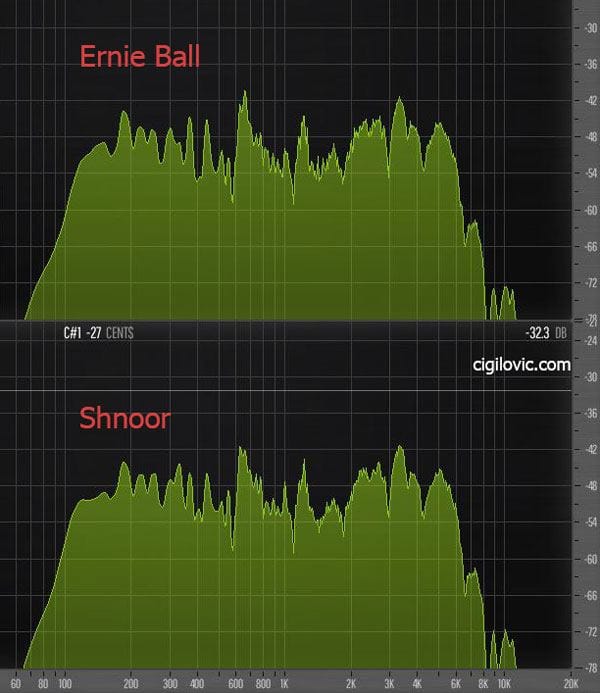
Now you have heard both cables and also been able to see snippets of spectral analysis of the same moment in the audio files. Post your second guesses and compare them to the correct answers below!
Do these help you to guess Cable 1 and Cable 2?
As a last remark before I reveal the correct answers, please do not take this as a scientific experiment or any kind of claim to look down on one cable. It’s just fun, and I’m a guitar nerd just like you! 🙂
I just wanted to give my visitors an insight into a simple analysis. I don’t think either of these cables sounds bad. They both sound great to me!
Excellent people at the Shnoor booth back in 2018 (Musik Messe, Frankfurt) gave this cable to me as a gift! Since then, I have been using their product. So I’m also using this opportunity to mention them again here on my blog. I hope Shnoor products will be available at Thomann! 🙂
At the end of the day, we, guitar nerds, always need to learn that the differences between products we use may be very little in terms of sonic characteristics. So before you spend your hard-earned cash on boutique cables, in this case, think again. You would probably be wasting your money. Always aim for long-lasting guitar cables first.
Correct Answer
[Drum Roll] Here is the correct match.
Cable 1: Ernie Ball instrument cable
Cable 2: Shnoor IC124 JMEJME
Later on, I did another blind test just for fun and published it as an article here. This time, I added one of my favourite cable brands, Cordial to the blind test and compared Ernie Ball, Shnoor and Cordial cables against each other.
Check out my Ernie Ball vs Cordial vs Shnoor Instrument Cables – Blind Test article here

Pricing & Availability
As you can see, Ernie Ball cables have been serving me well. They are so durable, noise and tangle-free cables! I’d also like to feature Shnoor and offer you some places to buy these cables. Unfortunately, Shnoor cables are not available due to the ongoing war, as the company is located in Russia. As I mentioned, I met those guys at the Frankfurt Musikmesse back in 2017, and I really wish them the best. I hope they can get back in business again soon. Last time I checked their website, it was still under construction. But feel free to contact them at the official Shnoor website here.
For Ernie Ball cables, I’d go to Thomann. Mind you, when I bought them, they were priced at €24.90, now listed at €21.90! That’s almost a 15% price reduction (got ripped off!:)). So, it’s a great time to buy these cables from Thomann.
Check out Ernie Ball cables on Thomann here
You can also check out Reverb, as there are many resellers there listing these brands.
Check out Ernie Ball cables on Reverb here
Last but not least, please also check out Amazon, as there are many resellers for these brands.
Check out Ernie Ball cables on Amazon here
I hope you have enjoyed this brief article and found my simple experiment insightful. Thanks for visiting my blog and supporting me so far! I will hopefully see you in the next review here!